Informasi Seputar Kegiatan di DPD RI
AGENDA KEGIATAN
DEWAN PERWAKILAN DAERAH REPUBLIK INDONESIA
25 September 2026 oleh admin
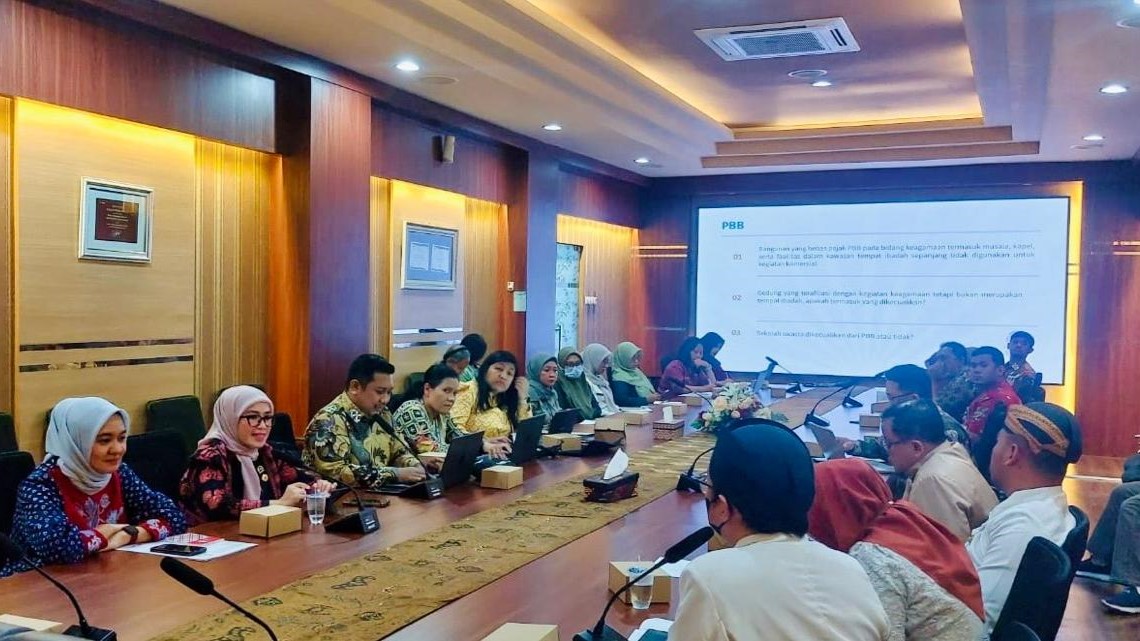
Surakarta, dpd.go.id — The Surakarta City Government has highlighted several challenges in implementing Law No. 1 of 2022 on Financial Relations between the Central Government and Regional Governments (HKPD Law). The various inputs were conveyed during a dialogue with the Documentation and Legal Information Network (DJIH) of the Center for Policy and Legal Studies (Pusperjakum), Secretariat General of the DPD RI, as part of an effort to inventory materials for an Annotated Review of Laws and Regulations related to the HKPD Law. The meeting was held at the Surakarta City Government Complex on Thursday (September 24).
The activity was part of the Pusperjakum Secretariat General of DPD RI’s provision of expert support to DPD RI members in carrying out their constitutional duties. Through the activity, the review team gathered various issues, experiences, needs, and input from regional governments concerning the implementation of the HKPD Law.
The results of the inventory will serve as material for preparing the review, which will subsequently be submitted to DPD RI members, particularly Committee IV of the DPD RI, which oversees financial relations between the central and regional governments.
Head of the DJIH Division at Pusperjakum, Secretariat General of DPD RI, and Head of the Review Team, Dr. Syulfah Sari Dewi Syam, expressed her appreciation to the Surakarta City Government, particularly the Regional Secretary and his staff, as well as academics who provided input during the inventory process.
“Through this activity, we want to hear and gather as much input as possible from regional governments and the public, particularly regarding the implementation of the HKPD Law. These inputs will serve as material for processing and preparing the review, so that it does not merely examine the regulatory aspects but also takes into account the issues and needs that emerge during implementation,” Syulfah said.
Surakarta Highlights the Need to Synchronize Central-Regional Financial Relations Surakarta City Regional Secretary Budi Murtono said the HKPD Law carries a positive spirit by providing regions with greater fiscal space to support the implementation of decentralization. However, its implementation still faces several challenges, particularly in synchronizing various provisions governing regional financial management.
“What is most frequently raised by regional governments concerns revenue, expenditure, financing, synchronization, and harmonization of central and regional financial relations,” Budi said.
According to him, national economic conditions and global dynamics also affect regional fiscal conditions, particularly in regions that do not have a natural resource base.
“The impact is felt at the regional level. Surakarta, for example, relies on the services sector and does not have natural resources. If the national and regional economies do not grow, regional revenues will also come under pressure. Therefore, the implementation of the HKPD Law needs to take into account the actual fiscal conditions of each region, not merely the legal framework,” he explained.
The Surakarta City Government also proposed that spending on teachers and healthcare workers be excluded from the calculation of the 30 percent mandatory spending requirement. According to the regional government, these two groups play an important role in delivering basic public services that have a direct impact on the community.
Meanwhile, Dean of the Faculty of Economics and Business at Universitas Sebelas Maret, Prof. Bimo Risky Samudro, presented an academic perspective on four key pillars of HKPD Law implementation: strengthening local taxing power, reducing vertical and horizontal fiscal disparities, improving the quality of regional spending, and harmonizing central and regional expenditure.
“Before 2022, central-regional financial relations focused more on fiscal balancing and transfers. Today, the focus has shifted toward strengthening digitalization, data and Budget Account Code (BAS) integration, funding evaluation, and the development of financing instruments,” Bimo explained.
He also emphasized that the success of HKPD Law implementation is determined not only by regulations, but also by human resource capacity, the quality of information systems, institutional capacity, and an orientation toward outcomes.
Closing the activity, Syulfah reaffirmed the review team’s commitment to preparing an objective review based on facts and conditions on the ground.
“The input and aspirations we received today will be important material for us to process and analyze further in preparing the Annotated Review of the HKPD Law. The findings will subsequently be submitted to DPD RI members, particularly Committee IV of the DPD RI,” Syulfah concluded.
AGENDA KEGIATAN
DEWAN PERWAKILAN DAERAH REPUBLIK INDONESIA