Informasi Seputar Kegiatan di DPD RI
AGENDA KEGIATAN
DEWAN PERWAKILAN DAERAH REPUBLIK INDONESIA
25 September 2026 oleh admin
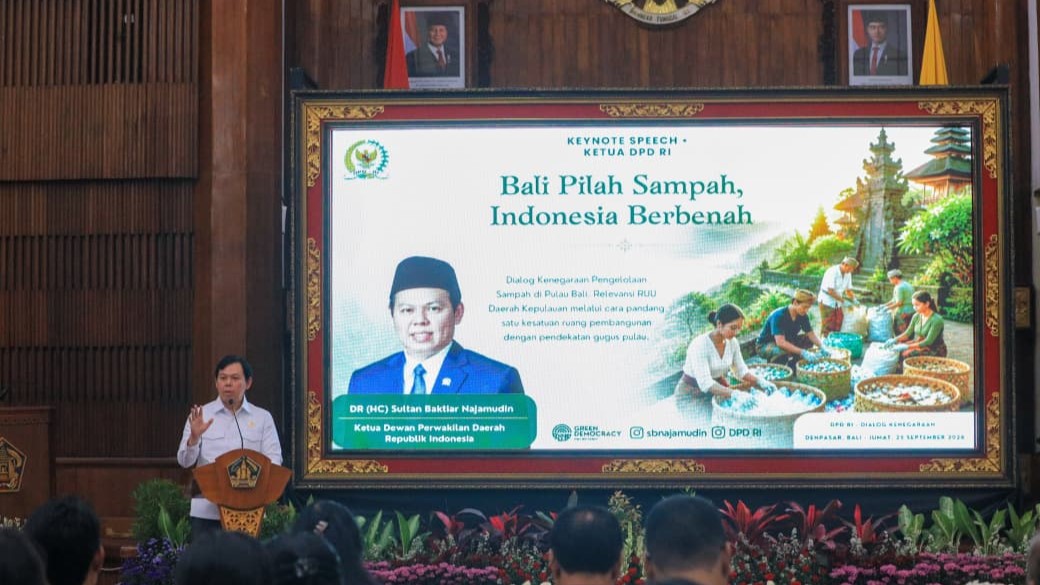
Denpasar, dpd.go.id — The Speaker of the House of Regional Representatives of the Republic of Indonesia (DPD RI), Sultan Baktiar Najamudin, encourages Bali to become a pioneer in the national waste-sorting movement. He believes the strength of traditional villages, hamlets, households, and the tourism industry is crucial for building community-based waste management.
"If Bali starts sorting, Indonesia must follow suit. Waste sorting must become a part of the culture," said Sultan during the DPD RI State Dialogue on Integrated Waste Management Based on Regional Community Ecosystems in Denpasar, Bali, on Friday (September 25, 2026).
According to Sultan, Bali has strong social capital through traditional villages, banjar (traditional community groups), cooperation (gotong royong), customary law (awig-awig), and pararem (community associations). This strength can serve as a foundation for building community discipline in reducing, sorting, and processing waste from the source. He emphasized that the old paradigm of "collect, transport, dispose" must be abandoned. Indonesia cannot talk about a green economy and Indonesia Emas 2045 if waste is still managed using outdated methods.
"Waste doesn't have to be a burden. With the right system, it can become value, energy, and jobs," said Sultan, accompanied by members of the Bali DPD RI, Ida Bagus Rai Dharmawijaya Mantra, Ni Luh Putu Ary Pertami Djelantik, and I Komang Merta Jiwa.
Sultan also highlighted the waste issue in the context of Indonesia's archipelagic state. Through the Archipelagic Region Bill, the DPD RI is promoting a land, sea, and air approach as a unified development space. Waste from land can end up on the coast and in the sea, and even travel between islands.
According to him, this approach is in line with the idea of Green Democracy, namely development that benefits today's generation without leaving an ecological burden on future generations.
"We learn from Bali. We mobilize from the regions. We build for Indonesia," Sultan emphasized.
Meanwhile, Bali Provincial Secretary Dewa Made Indra stated that the waste issue is an urgent priority for the Bali Provincial Government. Its complexity is influenced by various factors, ranging from population density, economic and tourism activities, technology, and public awareness. Therefore, Bali continues to encourage a paradigm shift from simply transporting and disposing of waste to reducing, sorting, processing, and leaving only residue.
"The principle is simple: my village is sustainable without plastic waste, my village is clean without polluting other villages. Waste must be resolved as close to the source as possible," said Dewa Made Indra.
Similarly, the Head of the Bali Provincial Forestry and Environment Agency (DKLH), I Made Dwi Arbani, added that source-based waste management continues to be strengthened through synergy between villages/sub-districts and traditional villages. Bali currently has 292 TPS3R (Recycling Sites for Waste Management) and 962 public waste banks.
"Waste management is a shared responsibility. Synergy is key to realizing a green, clean, and beautiful Bali," said Dwi Arbani.
Waste management practitioner Arbi Fuadi Mauldina of ecoBali/Waste4Change emphasized the need to shift the paradigm of waste management from a linear economy to a circular economy. He argued that waste management and sorting must begin at the source.
"The paradigm must shift from simply throwing away waste to responsible waste management and a circular economy," Arbi concluded.
Similarly, Ni Luh Kartini, Professor of Organic Agriculture at Udayana University, believes that villages and TPS3R (Recycling Waste Management Centers) must be strengthened as centers for waste management. Approximately 65 percent of waste is organic, which has the potential to be processed into compost, energy, and productive resources for agriculture.
"Waste must be addressed at the source. Villages and TPS3R (Recycling Sites) must be strengthened to transform waste from a burden into a resource and economic opportunity," Kartini concluded.**
AGENDA KEGIATAN
DEWAN PERWAKILAN DAERAH REPUBLIK INDONESIA