Informasi Seputar Kegiatan di DPD RI
AGENDA KEGIATAN
DEWAN PERWAKILAN DAERAH REPUBLIK INDONESIA
08 September 2026 oleh admin
JAKARTA, dpd.go.id — Committee II of the House of Regional Representatives of the Republic of Indonesia (DPD RI) has asked state-owned transportation enterprises (SOEs) to expand the meaning of national connectivity, not merely constructing infrastructure, but also ensuring that people across all regions gain access to safe, affordable, and sustainable transportation, including in underdeveloped, frontier, outermost, and border regions (3TP), while driving regional economic growth.
Vice Chairperson of DPD RI Committee II Angelius Wake Kako stated that transportation sector SOEs play a strategic role as operators, infrastructure managers, and executors of public service obligations and mandates, particularly in commercially non-viable areas.
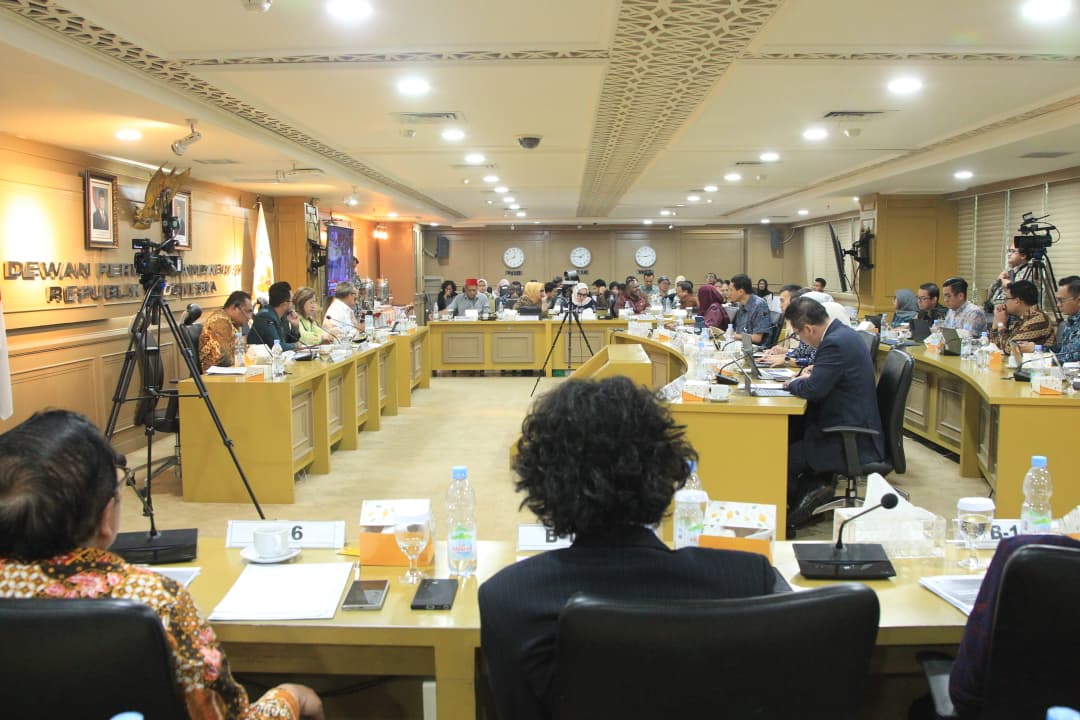
"We want to ensure that transportation development and implementation do not merely produce corporate achievements, but truly answer regional needs. Therefore, through this meeting, we wish to objectively assess the gaps between policy and execution, including equity of service, intermodal integration, safety, financing, and public services in 3TP regions," Angelius said alongside Vice Chairperson of Committee II La Ode Umar Bonte while opening the Hearing (RDP) of DPD RI Committee II with transportation SOEs regarding the implementation of transportation laws at the DPD RI Building, Parliament Complex, Senayan, Jakarta, on Tuesday (September 8, 2026).
In his presentation, President Director of PT Jasa Marga Rivan Achmad Purwantono shared that toll roads serve a strategic role as the backbone of Indonesia's land connectivity. Toll roads not only accelerate public mobility and logistics distribution, but also connect economic hubs, industrial zones, ports, airports, and other transport nodes.
According to him, toll road development must form part of an integrated national transportation system, even while facing ongoing challenges such as Over Dimension Over Loading (ODOL) vehicles, land-use changes, spatial conversion of right-of-way zones, and uneven traffic distribution. To address these, Jasa Marga advocates for strengthened oversight using Weight-in-Motion (WIM) technology, RFID, data integration, pavement engineering, and traffic management.
"Toll roads do not simply connect locations; they link multimodal transport, economic centers, and logistics supply chains," Rivan said.
Furthermore, Director of Operations and Transformation at ASDP Rio Theodore Natalianto Lasse emphasized that ferry services hold a strategic role in bolstering national connectivity, particularly as links between islands, economic centers, and 3TP regions. ASDP currently manages 37 ports, 343 routes, and 225 vessels, while generating economic impact with a GDP contribution of Rp28.2 trillion, fiscal contribution of Rp1.55 trillion, and the creation of 12.8 thousand jobs. ASDP is also driving a shift in logistics transport from land to sea via Ro-Ro/Ro-Pax services to cut logistics costs, reduce road wear, and enhance transport safety.
"Policies are needed to align fuel quotas with new routes, guarantee the sustainability of pioneer services through the Public Service Obligation (PSO) scheme, and strengthen oversight to support national connectivity. Additionally, national data integration and multimodal transport network planning are necessary," Rio said.
At the forum, Director of Passenger Transport at PT PELNI Nuraini Dessy W. asserted that PELNI plays a vital role in maintaining inter-island connectivity, especially in commercially non-viable 3TP regions. PELNI currently operates a network covering 43 branches, 306 terminal points, 357 ports of call, and 1,111 route segments, with PSO services acting as a vital instrument to guarantee that communities in remote areas maintain access to affordable maritime transport.
"PSO allows PELNI to continue serving commercially non-viable 3TP areas while preserving national connectivity. As such, service sustainability requires government support, including budget certainty and PSO schemes capable of sustaining operations and fleet modernization," Nuraini stated.
At the same time, Commercial Director of PT Angkasa Pura Indonesia Very Y. Setiady noted that air connectivity continues to be strengthened through the expansion of domestic and international route networks, airport capacity upgrades, and service transformation to meet growing mobility. Up to July 2026, 104 new routes were realized, consisting of 79 domestic and 25 international routes. Meanwhile, for the August–December 2026 period, an additional 41 new routes are projected.
"Strengthening connectivity is not just about adding flight routes, but ensuring that airport capacity, service quality, and infrastructure are equipped to support mobility growth and open access across regions," Very noted.
Closing the meeting, Chairperson of DPD RI Committee II Badikenita Sitepu expressed hope that the input gathered would serve as material for Committee II's legislative and supervisory duties, the formulation of recommendations for the government, and the strengthening of the legal framework when drafting a National Connectivity Bill that is equitable and responsive to regional needs.
"We hope this meeting serves not only to showcase corporate accomplishments, but also to identify the gaps between legal provisions and their actual implementation," Badikenita concluded.
AGENDA KEGIATAN
DEWAN PERWAKILAN DAERAH REPUBLIK INDONESIA