Informasi Seputar Kegiatan di DPD RI
AGENDA KEGIATAN
DEWAN PERWAKILAN DAERAH REPUBLIK INDONESIA
07 May 2026 oleh admin
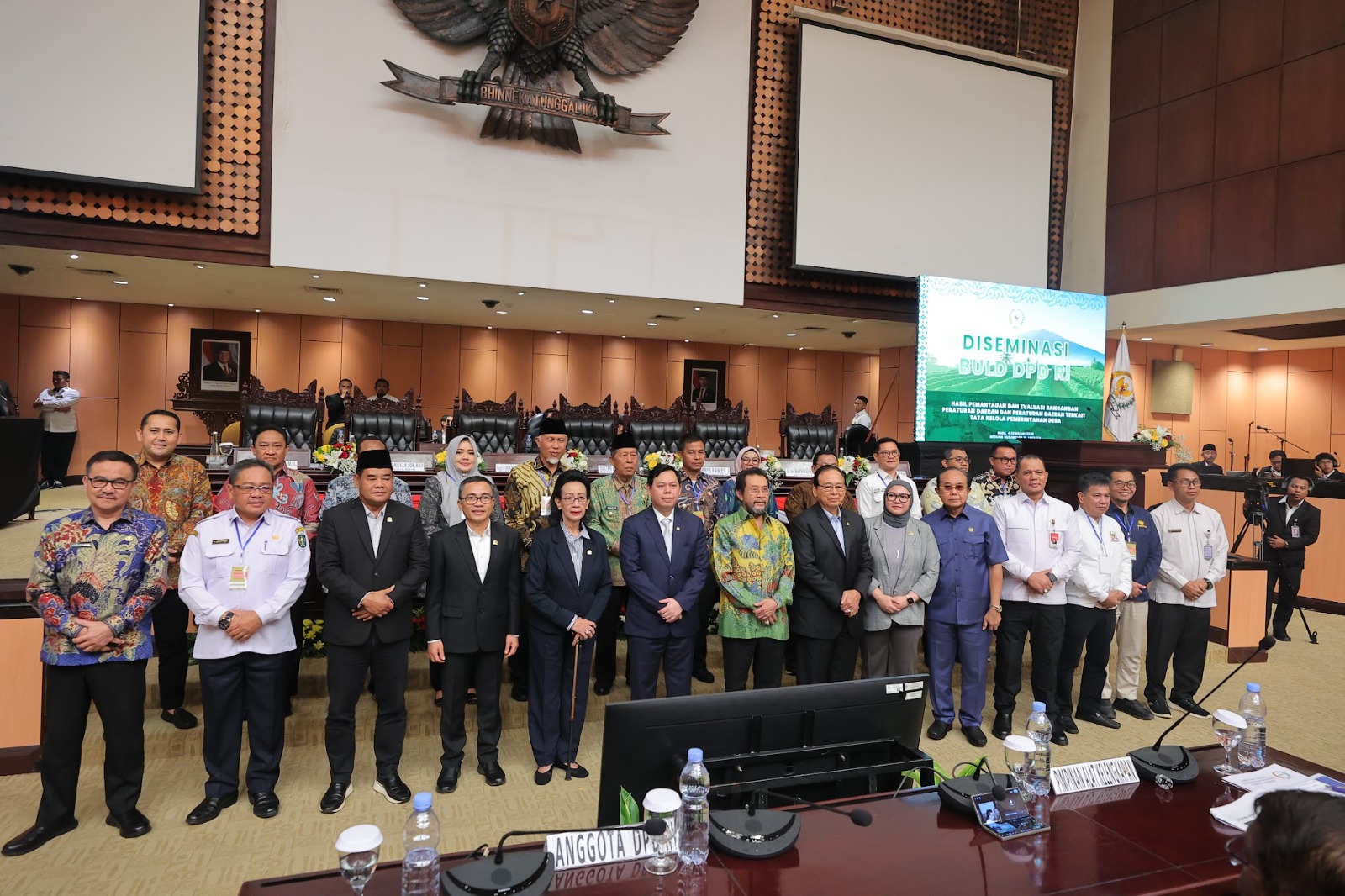
Jakarta, 5/5/2026 — The House of Regional Representatives of the Republic of Indonesia (DPD RI) officially Ratified the Monitoring Results of the DPD RI Regional Legislation Committee (BULD) regarding the Follow-up on DPD RI Decree Number 33/DPD RI/III/2024–2025 concerning the Results of Monitoring and Evaluation of Draft Regional Regulations and Regional Regulations Related to Village Government Governance. This took place during the 9th Plenary Session of the IV Session Period for the 2025–2026 Sitting Year, held on April 24, 2026.
This approval is a follow-up to the comprehensive monitoring process conducted by the BULD DPD RI regarding the response of both central and local governments to previously submitted strategic recommendations. The monitoring document was previously presented within the DPD RI institutional forum as part of the constitutional oversight mechanism for the harmonization of central and regional legislation.
Substantively, the monitoring results emphasize that village government governance still faces structural and normative challenges, including regulatory disharmony, overlapping cross-sectoral policies, and limited village institutional capacity. In this context, the DPD RI, through the BULD, assesses that the government's follow-up on the provided recommendations shows significant progress, particularly in the aspect of forming derivative regulations as operational instruments for village policy implementation.
One of the primary achievements highlighted in this report is the acceleration of the drafting and enactment of Government Regulations as implementing regulations for the Village Law. This step is regarded as a concrete response from the Government to the DPD RI’s recommendations, which emphasized the urgency of providing a comprehensive legal basis to address legal vacuums and policy disharmony. This acceleration also addresses the demands of various stakeholders, including local governments and village associations, who have long faced confusion due to overlapping ministerial regulations.
The Government officially enacted Government Regulation Number 16 of 2026 on March 27, 2026, as an implementing regulation for Law Number 6 of 2014 concerning Villages, as most recently amended. This enactment serves as a significant milestone in strengthening the legal framework for village governance nationwide.
The existence of this Government Regulation is expected to provide legal certainty while simultaneously simplifying village regulations through a cross-sectoral harmonization approach. Normatively, the provisions in this Government Regulation cover crucial aspects, including the fixed income (siltap) of village officials, increased social security for village apparatus, and the simplification of regulations that were previously scattered across various sectoral policies.
Furthermore, this acceleration process was conducted through systematic stages, starting from the completion of the draft in early 2026, cross-ministerial/institutional harmonization, to socialization with local governments prior to enactment. Consequently, the resulting policy is not merely normative but also implementable and responsive to the real needs of village administrations. From an institutional perspective, the DPD RI emphasizes that the success of this follow-up reflects the importance of the regional legislative oversight function in ensuring that national policies align with the needs of regions and villages. These monitoring results also underscore the necessity of strengthening synergy between the central government, regional governments, and village governments to realize village governance that is accountable, transparent, participatory, and equitable.
As a follow-up to this ratification, the DPD RI, through the BULD, will continue to conduct ongoing monitoring to ensure that policy implementation runs effectively and remains aligned with the principles of recognition and subsidiarity, which serve as the primary foundation for village regulation in Indonesia.
AGENDA KEGIATAN
DEWAN PERWAKILAN DAERAH REPUBLIK INDONESIA