Informasi Seputar Kegiatan di DPD RI
AGENDA KEGIATAN
DEWAN PERWAKILAN DAERAH REPUBLIK INDONESIA
24 August 2026 oleh admin
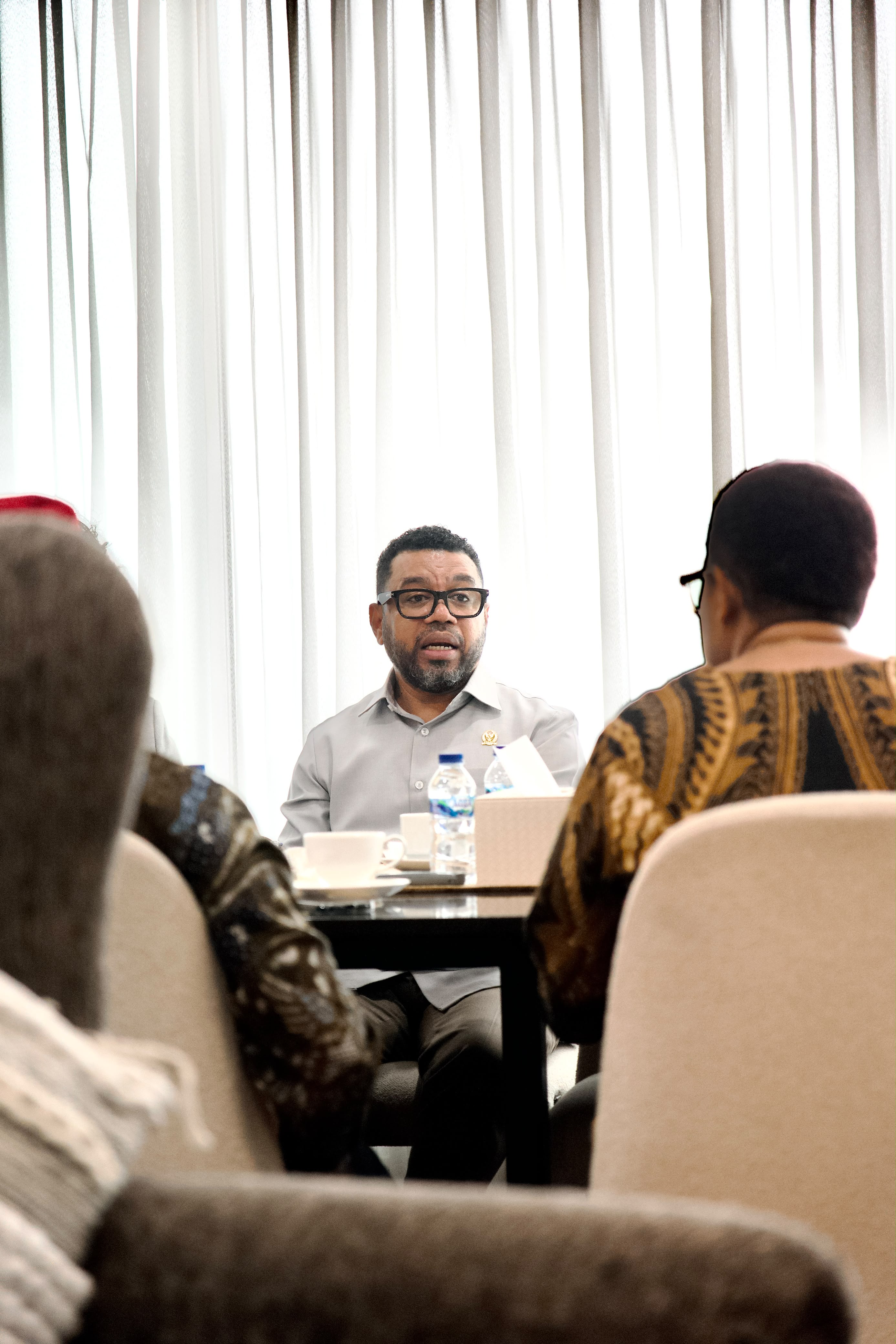
Jakarta, dpd.go.id — Member of the House of Regional Representative of the Republic of Indonesia (DPD RI) for the West Papua electoral district, Dr. Filep Wamafma, believes that the relationship between the central and regional governments needs to be evaluated comprehensively in order to maintain the spirit of reform and the constitutional mandate.
According to Filep, the issue of central and regional relations is not only related to the division of administrative authority, but also to maintaining constitutional justice, people's welfare, natural resource management, democracy, equitable development, and the future of the Republic of Indonesia.
"I speak as a member of DPD RI) from the West Papua electoral district. This is my personal view. As a regional representative, I have a moral responsibility to convey the concerns, aspirations, and problems felt by the people in the region," said Filep.
Filep emphasized that regional autonomy is part of the constitutional design of the Republic of Indonesia according to Article 18 paragraph (2) of the 1945 Constitution of the Republic of Indonesia which states that regional governments can regulate and manage their own government affairs according to the principles of autonomy and assistance tasks.
In fact, Article 18 paragraph (5) emphasizes that regional governments exercise the broadest possible autonomy, except for government affairs which are determined by law to be the affairs of the Central Government.
Meanwhile, Article 18A and Article 18B provide a constitutional basis for the relationship of authority and finance between the central and regional governments as well as recognition of the uniqueness and diversity of regions.
"If, in practice, regional government administration shows a tendency for regional authority to be increasingly shifted to the central government, an evaluation must be conducted. Reduced regional autonomy must be proportionally restored to the spirit of the constitution and the spirit of the 1998 Reformation," he stressed.
Filep reminded that decentralization was an important response to the experience of highly centralized governance before the Reformation.
According to him, the enactment of Law No. 22 of 1999 concerning Regional Government and Law No. 25 of 1999 concerning Financial Balance between the Central and Regional Governments was an important milestone in changing the relationship between the central and regional governments.
Therefore, the spirit of Reform does not stop at political change, but must continue to be realized in the design of constructive central and regional relations.
"After more than two decades of reform, we must not return to an overly centralized pattern of central-regional relations. Reform must strengthen the regions, not make them mere implementers of central policy," he said.
He assessed that the reduction in regional space in the areas of government, fiscal, personnel, licensing, natural resource management, and development should be the subject of a national legal policy evaluation.
According to him, government efficiency is indeed important, but efficiency should not be a reason to eliminate the substance of regional autonomy.
Furthermore, the issue of regional autonomy, according to Filep, cannot be separated from the management of natural resources. He reminded that Article 33 paragraph (3) of the 1945 Constitution of the Republic of Indonesia states that the earth, water and natural resources contained therein are controlled by the state and used for the greatest prosperity of the people.
"If a region possesses extraordinary natural resources, but the people surrounding those resources still live in poverty, then questions arise about the fairness of managing those resources," Filep said.
He added that Papua has vast natural resources, but a number of regions in Papua still face issues of poverty, education, health, infrastructure, employment, and limited access to basic services.
"Papua's wealth must be seen as a constitutional mandate. Natural resources should not merely generate revenue for the state, but must also produce real change in the lives of the Papuan people, especially Indigenous Papuans," he said.
According to BPS data, the West Papuan senator continued, poverty levels are still a serious problem in a number of regions in Papua. By September 2025, the poverty rate in Papua reached 17.82 percent. In Highlands Papua, it reached 27.21 percent, and in Central Papua, it reached 29.45 percent. Filep believes this data should serve as a policy wake-up call.
"The most important thing in our policy focus is how many people are able to escape poverty, how many children receive quality education, how many people receive health services, and how many jobs are created," he said.
Filep reminded the government not to view every regional criticism as a threat to the Unitary State of the Republic of Indonesia. He argued that the emergence of public dissatisfaction should be seen as an early warning system for the state.
"Public trust in the government is vital. The state must intervene before dissatisfaction escalates into a larger conflict," he said.
Therefore, the solution must intensively focus on dialogue, justice, development, welfare, respect for indigenous peoples, and fair distribution of authority as the main part in strengthening national integration.
"When local communities receive justice, have adequate authority, enjoy the benefits of natural resources, receive adequate education and healthcare, and feel respected as part of Indonesia, their sense of belonging to the Unitary State of the Republic of Indonesia will grow stronger," Filep emphasized.
"Unity must be built through justice. National integration must be built through prosperity. And trust in the state must be built through a real state presence," he further explained.
Filep also reminded that the experience of a number of countries shows that the relationship between the central and regional governments is a fundamental issue in maintaining national stability.
"Spain developed a broad system of regional autonomy within a unitary state. Belgium developed into a federal state to manage its territorial and linguistic diversity. Canada granted provinces extensive powers in a number of areas," he explained.
On the other hand, the experience of various countries shows that issues of identity, distribution of resources, inequality, and central-regional relations can become sources of conflict if not managed through just political institutions.
"We must learn that national unity requires justice, respect for diversity, and a design of central-regional relations that makes people feel like they are equal members of the nation," he said.
Based on this, Filep is pushing for a comprehensive evaluation of the legal policy of central-regional relations post-Reformasi. He believes this evaluation should include: Division of central and regional authority; Fiscal decentralization and financial balance; Sharing of natural resource benefits; Regional authority in development and licensing; Strengthening local government capacity; Protection of indigenous communities and regional specialization; Evaluation of the implementation of Special Autonomy for Papua and Aceh; Equal distribution of education and health; Reducing inter-regional disparities; and Increasing regional participation in national policies that have a direct impact on the regions.
"Regional autonomy must be returned to the spirit of the constitution. This is not to weaken the central government, but to ensure that the state operates according to the principles of a fair and democratic division of authority," said Filep.
"I need to emphasize once again that I am not representing the DPD RI institution. This is my personal view as a DPD RI member from West Papua. I express this view because I have witnessed the regional issues firsthand and have a moral responsibility to speak up for the interests of the people I represent," he concluded.
AGENDA KEGIATAN
DEWAN PERWAKILAN DAERAH REPUBLIK INDONESIA