Informasi Seputar Kegiatan di DPD RI
AGENDA KEGIATAN
DEWAN PERWAKILAN DAERAH REPUBLIK INDONESIA
25 August 2026 oleh admin
Jakarta, dpd.go.id – The fight to establish the Bill on Archipelagic Regions (RUU Daerah Kepulauan) has entered a crucial phase. As tripartite discussions alongside the DPR RI (House of Representatives of the Republic of Indonesia) and the government continue, the DPD RI (House of Regional Representatives of the Republic of Indonesia) is strengthening its consolidation with the regions to ensure that the bill directly addresses the real issues faced by archipelagic communities.
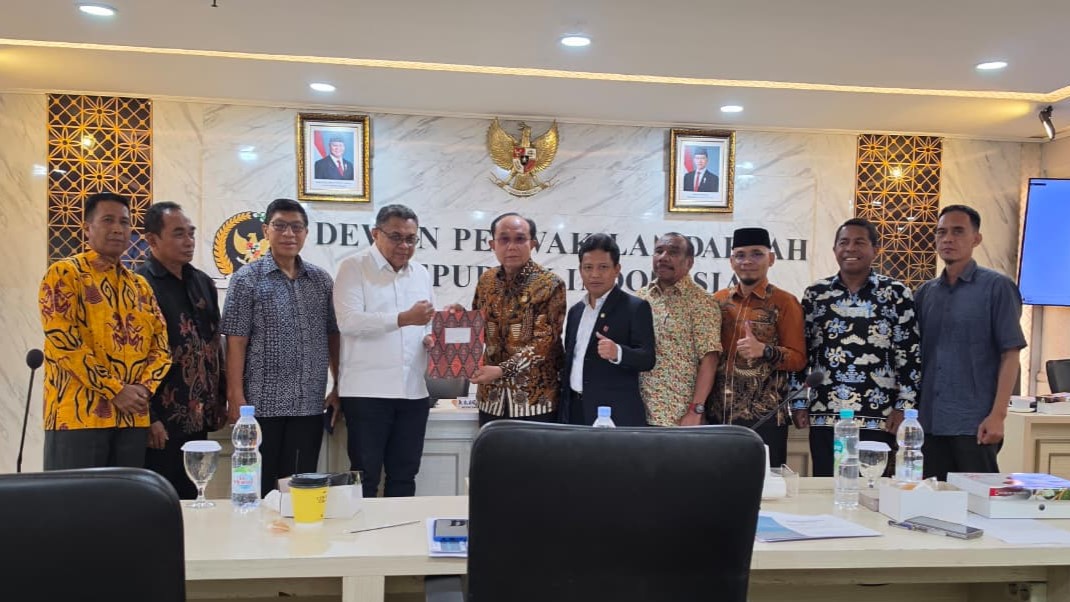
During a Consultation Meeting with the Technical Team of the Archipelagic Provinces Cooperation Board (BKS Provinsi Kepulauan) at the DPD RI Parliament Complex, Jakarta, on Monday (August 24, 2026), the DPD RI Archipelagic Regions Bill Task Force, led by Task Force Chair Andi Sofyan Hasdam and Vice Chair Abdul Kholik, gathered strategic input regarding maritime territorial authority, the management of marine and fisheries resources, island-cluster-based development and connectivity, as well as funding schemes for archipelagic regions. This input will serve as material to reinforce the DPD RI’s stance during deliberations on the Problem Inventory List (DIM) of the Archipelagic Regions Bill.
Chair of the DPD RI Archipelagic Regions Bill Task Force, Andi Sofyan Hasdam, stated that deliberations on the bill must no longer stop at normative debates. The current momentum must be leveraged to consolidate data, arguments, and the actual needs of archipelagic regions so that the resulting legislation is truly actionable.
“The Archipelagic Regions Bill must stem from the real problems faced by the regions. Therefore, input from the regions is essential to ensure that the provisions we are fighting for have a solid foundation and are capable of meeting the needs of island communities,” said the Senator from East Kalimantan.
Andi explained that the Archipelagic Regions Bill entered tripartite deliberations within the DPR RI Special Committee (Pansus) on June 25, 2026. This stage was followed by joint discussions with ministries, agencies, experts, academics, and stakeholders to formulate the Problem Inventory List (DIM), including joint working visits to the Kepulauan Riau and Maluku regions. The scope of the bill has also been expanded from eight to ten archipelagic provinces.
According to Andi, consultations with the BKS Archipelagic Provinces Technical Team form part of an effort to ensure that regional voices remain the core foundation in refining the bill.
“The DPD RI carries a mandate from the regions. Therefore, as this bill enters increasingly substantive deliberations, we must ensure that the interests of archipelagic regions are not only heard, but truly translated into enforceable norms and policies,” he said.
Andi emphasized that consolidation between the DPD RI and regional governments becomes all the more critical amid growing political momentum behind the bill's deliberation. President Prabowo Subianto previously touched upon the Archipelagic Regions Bill in his address during the Annual Session of the MPR RI and the Joint Session of the DPR RI and DPD RI on August 14, 2026, expressing optimism regarding its completion.
“Our task now is to safeguard that momentum with robust substance. This bill must not end up as a mere regulation on paper; it must become a law capable of paving the way for accelerated development and public welfare in archipelagic regions,” Andi stressed.
Meanwhile, Vice Chair of the DPD RI Archipelagic Regions Bill Task Force, Abdul Kholik, added that the core spirit of this bill is not to make archipelagic regions increasingly dependent on the central government. On the contrary, the bill must open up space for regions to optimize their own potential to strengthen their economic and fiscal capacities.
According to Abdul Kholik, the inherent characteristics of archipelagic areas which possess immense potential in marine sectors and territorial resources must be translated into regional development strength. Therefore, provisions governing authority must be designed so that regions are not merely passive recipients of policy, but gain stronger leverage to develop their potential and resources in line with their respective characteristics.
“What we want to build are archipelagic regions that grow stronger in accordance with their geographical characteristics and operational difficulties, where regions are given room to grow, innovate, and maximize their full potential,” he said.
During the consultation meeting, the Technical Team of the BKS Archipelagic Provinces pushed for development and funding provisions that account for the special characteristics of island territories, including island-cluster-based regional development and the strengthening of connectivity. Additionally, the legal standing of the bill is being pushed to provide more affirmative and asymmetrical regulations tailored to the specific characteristics of archipelagic territories.
AGENDA KEGIATAN
DEWAN PERWAKILAN DAERAH REPUBLIK INDONESIA