Informasi Seputar Kegiatan di DPD RI
AGENDA KEGIATAN
DEWAN PERWAKILAN DAERAH REPUBLIK INDONESIA
19 August 2026 oleh admin
DPD RI Committee III appreciates the policy and commitment of President Prabowo Subianto in efforts to strengthen teachers' welfare, reorganize educational personnel, and provide affirmative action for teachers serving in areas with difficult geographical and social conditions.
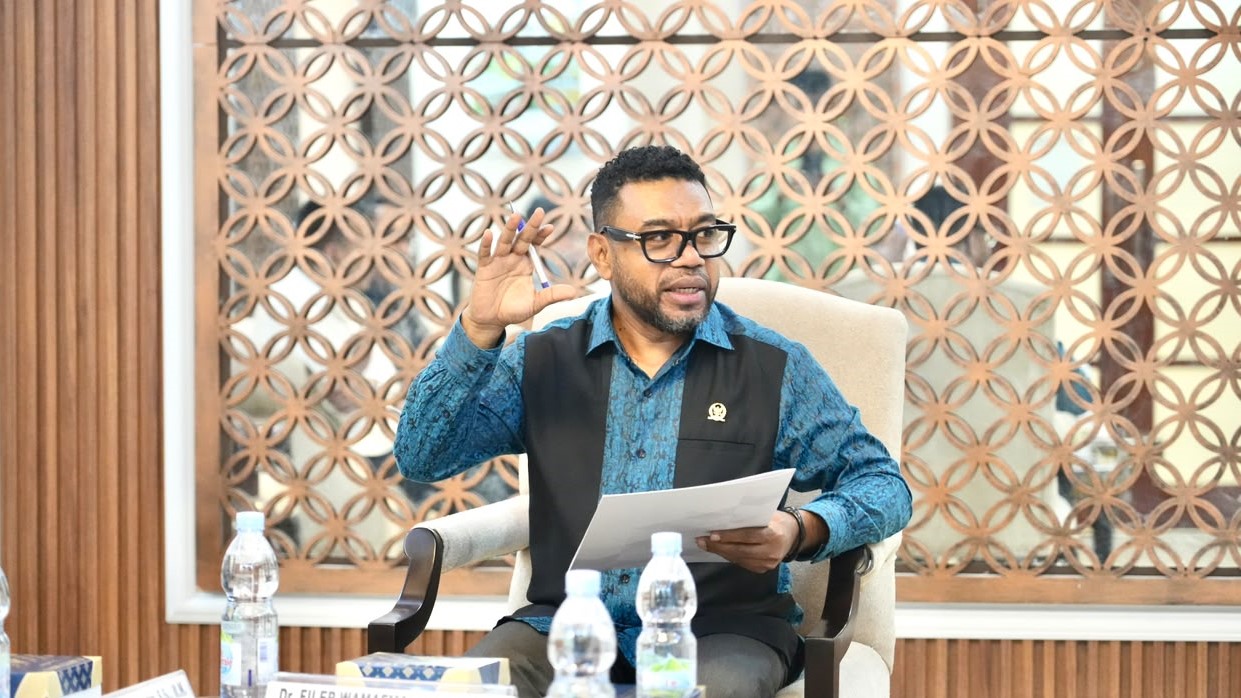
The Chairperson of Committee III of the DPD RI, Dr. Filep Wamafma, views the policy as a strategic and crucial political step by the state. According to him, from the perspective of legal policy (politik hukum), good executive policy must be transformed into strong, binding, sustainable legal norms that provide certainty.
"Committee III of the DPD RI previously noted that the management and transition of honorary workers toward PPPK (Government Employees with Work Agreements) is one of the essential steps in civil service governance reform. Therefore, we appreciate the government's recent policy moves regarding the arrangement of PPPK teachers. For teachers, the critical points needed include clarity of status, decent income, career pathways, and legal protection. These matters can be institutionalized into the national legal system," emphasized the leader of Committee III of the DPD RI, which oversees the education sector.
Data from the National Civil Service Agency (BKN) indicates that as of December 31, 2025, there were 2,299,056 teacher civil servants (ASN), consisting of 1,139,140 PNS (Civil Servants), 989,401 PPPK, and 170,515 part-time PPPK. Consequently, around 43 percent of teacher civil servants hold full-time PPPK status, and approximately 7 percent are recorded as part-time PPPK. Previously, BKN also recorded that during the 2024 PPPK selection process, 878,627 people obtained full-time PPPK positions out of a total of 1,008,337 allocated positions.
"These figures demonstrate that the government has made significant changes to the governance of educational personnel. However, the next legal policy challenge is ensuring that this change in status truly delivers welfare and legal clarity, rather than being a mere administrative shift in civil service nomenclature," Filep added.
Welfare Must Be Bound by Legal Certainty Furthermore, the West Papua senator added that the government had raised PPPK salaries through Presidential Regulation (Perpres) Number 11 of 2024, which amended Perpres Number 98 of 2020 on PPPK Salaries and Allowances. This regulation serves as an important foundation for determining PPPK salaries based on pay grade and length of service.
"Committee III of the DPD RI views teachers' welfare as something that cannot be measured solely by nominal salary. Instead, it must be comprehensively understood to include status and employment clarity, decent income and allowances, social security, career development, access to education and certification, legal protection, occupational safety guarantees, and welfare assurance after reaching retirement," he explained.
Accordingly, he stressed that educational legal policy must reinforce a rights-based approach by positioning teacher welfare and protection as part of state-guaranteed rights.
Affirmative Actions for 3T Teachers Must Be Strengthened Additionally, Filep expressed appreciation for the government's special attention to teachers serving in underdeveloped, frontier, and outermost (3T) regions. In 2026, the government increased the target number of special allowance recipients for teachers in 3T areas and disaster-affected areas from 57,683 to 65,871 teachers.
Specifically for non-ASN teachers serving in areas with special geographical conditions or 3T regions, the government allocates a Special Teacher Allowance (Tunjangan Khusus Guru or TKG) of IDR 2 million per person per month. In 2026, the TKG budget reaches approximately IDR 706 billion, benefitting 28,892 teachers. This budget reflects an increase of roughly IDR 95 billion compared to the previous year.
"Committee III of the DPD RI appreciates this affirmative policy. However, the challenges faced by 3T teachers extend beyond earnings. They contend with geographical isolation, high transportation costs, limited educational infrastructure, internet access constraints, limited health services, as well as specific social and security conditions. Therefore, the special allowance must be viewed as an instrument of state affirmative action, not merely as additional income," he noted.
Regarding the context of Papua, he believes policies directed at teachers must account for regional characteristics and the affirmative mandate within the framework of Special Autonomy (Otonomi Khusus). In his view, the government needs to offer stronger affirmative action through incentives based on regional hardship levels, occupational safety and legal protection guarantees, housing facilities, transportation support, accelerated certification, competency development access, and special assistance for teachers operating under specific geographical and security conditions.
"Committee III of the DPD RI considers that the most fundamental issue is not just how large the teacher allowance is today, but how strongly the state guarantees the sustainability of that right in the future. Teacher welfare policy must possess fiscal, institutional, and legal continuity. Teachers should not experience certainty only while a program is running, only to face uncertainty once policy changes occur," he stated.
Consequently, Committee III of the DPD RI encourages the government and the House of Representatives (DPR RI) to view teacher issues not merely as administrative civil service matters, but as a matter of constitutional rights to education and human development.
"We in Committee III of the DPD RI will also continue to utilize our oversight functions, legislation related to DPD authority, and regional aspiration channels to ensure government policies truly reach teachers in the regions. We appreciate the President for demonstrating advocacy for teachers. The future of teachers must be made clearer," Filep expressed.
"Committee III of the DPD RI reaffirms that securing the future of teachers is an integral part of securing the future of Indonesian education. A nation aiming to build an exceptional generation cannot leave its educators in a state of uncertainty. If teachers are prosperous and protected, the future of Indonesian education will undoubtedly grow stronger," he concluded.
AGENDA KEGIATAN
DEWAN PERWAKILAN DAERAH REPUBLIK INDONESIA