Informasi Seputar Kegiatan di DPD RI
AGENDA KEGIATAN
DEWAN PERWAKILAN DAERAH REPUBLIK INDONESIA
24 August 2026 oleh admin
Solo, dpd.go.id — Article 33 of the 1945 Constitution is once again under scrutiny as President Prabowo Subianto pushes to restore the constitutional mandate to national development practices. For Tamsil Linrung, Vice Speaker of the House of Regional Representatives of the Republic of Indonesia (DPD RI), the issue is no longer how Article 33 is understood, but how strongly the public feels about its mandate.
Tamsil stated that state control over natural resources and strategic production sectors should not cease to be a constitutional concept. This control must be translated into policies that create added value, employment, equity, and prosperity for the people.
"DPD RI supports the government's steps and policies to restore Article 33 to the national development arena," Tamsil added in a statement to the media on Monday (August 24).
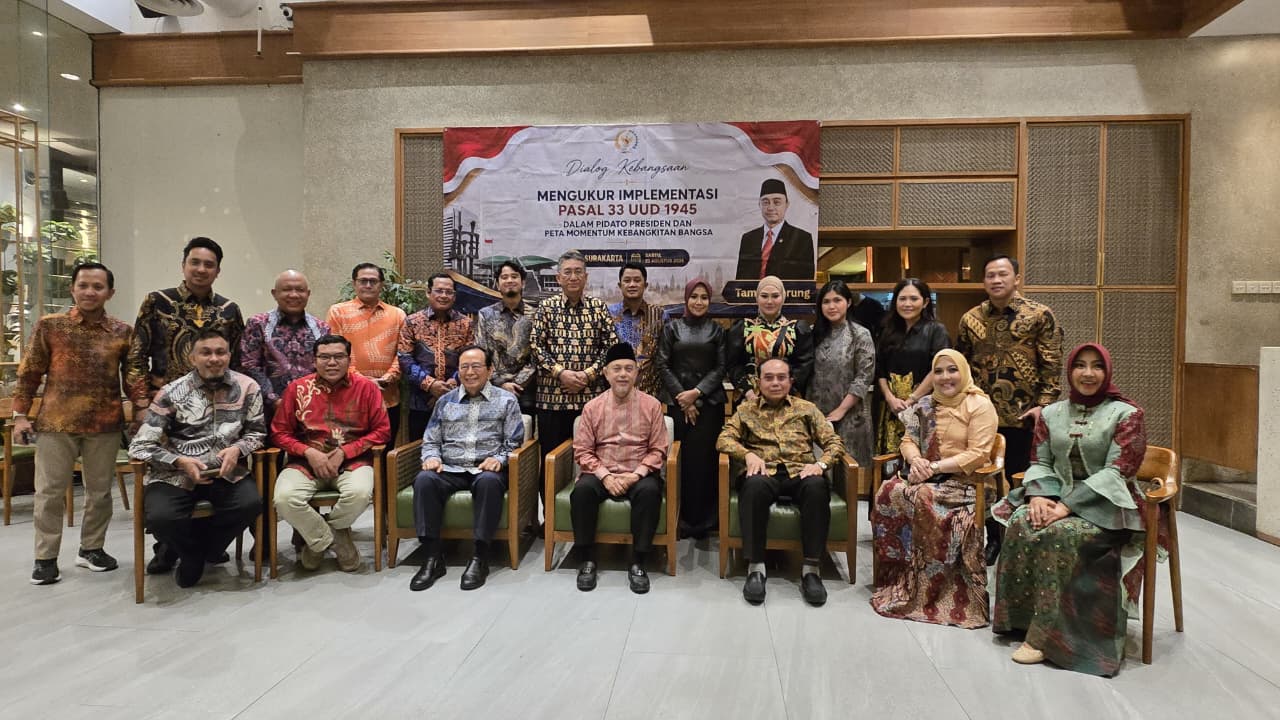
Tamsil made this statement after attending a sharing session with political observer Pangi Syarwi Chaniago in Solo, Central Java, along with several members of the DPD RI for Eastern Sub-Region 1. Jusman Dalle, Expert Staff to the Vice Speaker of the DPD, moderated the discussion, which was attended by 31 DPD members from Sulawesi and Kalimantan. The discussion focused on national political dynamics and economic issues, particularly the implementation of Article 33 of the 1945 Constitution and the DPD’s role in overseeing the government's strategic agenda. For Tamsil, Article 33 must be read as a mandate that demands results. The state is not sufficient merely to hold authority, but must ensure that authority is used for the greatest prosperity of the people.
"I mentioned earlier that its implementation, once again, is locked by Article 33 paragraph 3, but it hasn't been used for the greatest prosperity of the people. That's our concern, and it's also drawn the President's attention," Tamsil said during the discussion.
He reminded that discussions about Article 33 cannot be separated from the second paragraph, which regulates sectors of production that are vital to the state and affect the livelihoods of many people. Therefore, according to Tamsil, the measure of success in implementing Article 33 does not stop at who controls resources. The more fundamental question is what benefits that control brings to the people.
Another question that arose was whether the public felt the impact of Article 33. This was expressed by political observer and Voxpol Center Founder Pangi Syarwi Chaniago. He argued that there was a gap between the constitutional mandate and the actual experiences of the public on the ground. This statement became a key point in the discussion. This is because Article 33 is not merely a norm regarding state control over the economy. It also mandates that the management of national wealth be transformed into the welfare of the people.
Pangi views the implementation of Article 33 as a strategic agenda, yet it faces challenges from major powers. He illustrates the President's attempt to dive into the deep sea to catch a big fish. However, many are disturbed. Many feel stronger than the state. Therefore, Pangi reminded the President to prepare from the outset for counter-resistance.
Pangi also compared Indonesia to a goat farmer. Despite having many goats, he never enjoys goat satay because they've all been sold. "The ones enjoying goat satay are other people, other nations," Pangi emphasized.
AGENDA KEGIATAN
DEWAN PERWAKILAN DAERAH REPUBLIK INDONESIA