Informasi Seputar Kegiatan di DPD RI
AGENDA KEGIATAN
DEWAN PERWAKILAN DAERAH REPUBLIK INDONESIA
09 September 2026 oleh admin
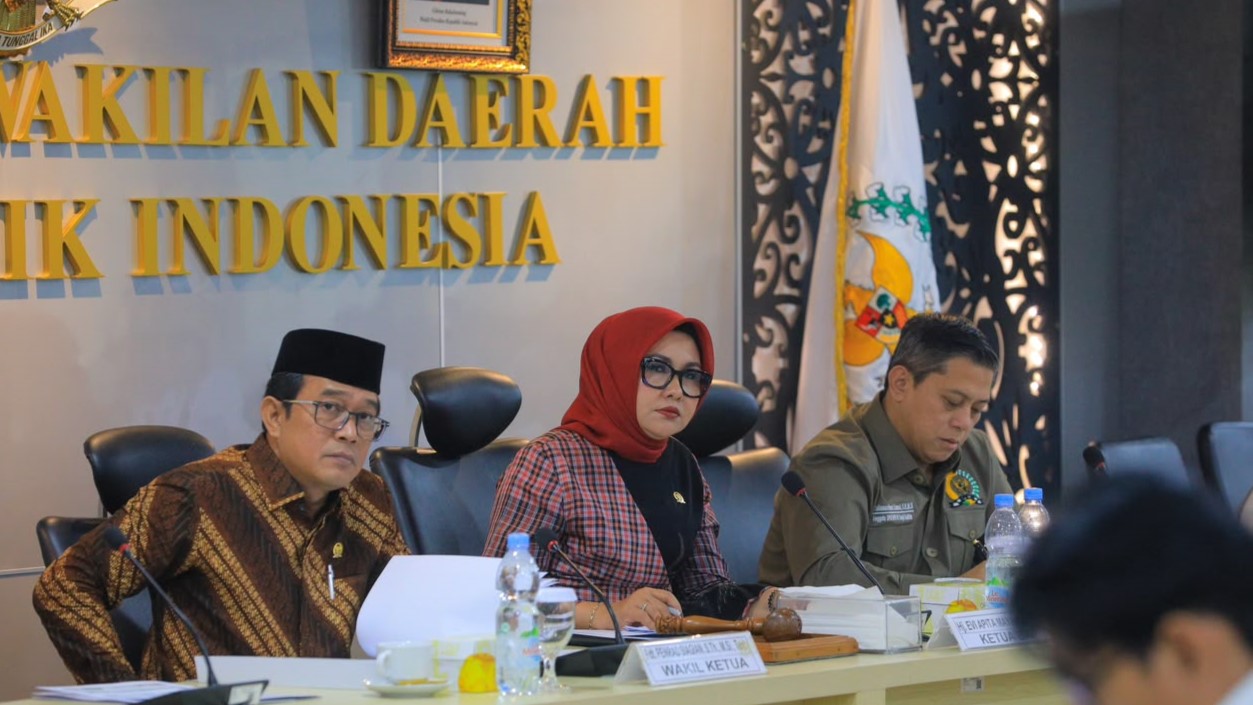
Jakarta, dpd.go.id - The Public Accountability Board (Badan Akuntabilitas Publik or BAP) of the House of Regional Representatives of the Republic of Indonesia (DPD RI) ensures that 12 public complaints from various regions do not remain mere administrative documents, but are followed up with concrete actions, clear responsible parties, and monitorable completion targets. This commitment was emphasized during a Hearing (Rapat Dengar Pendapat or RDP) with community members, ministries/institutions, and stakeholders in the Kutai Room, Parliamentary Complex, Senayan, Jakarta, Wednesday (Sept 9, 2026).
Chairperson of BAP DPD RI, Evi Apita Maya, stated that the Hearing is part of DPD RI's oversight function as well as a forum to bring together the community and relevant ministries/institutions to seek resolutions for the various issues raised.
“We want to ensure that public complaints do not stop as administrative documents. Every complaint must have a clear follow-up: who is responsible, what the steps toward resolution are, and when the target completion date is,” Evi said.
The 12 complaints encompass issues regarding certainty over land rights, development projects, business activities, environmental protection, and labor rights. A number of these issues had previously been discussed through Hearings/Public Hearings (RDP/RDPU) and official working visits, forming part of DPD RI's recommendations in the previous session.
During the Hearing, BAP discussed issues including the Complete Systematic Land Registration (PTSL) program in West Nusa Tenggara, alleged land grabbing and illegal occupation in South Kalimantan, land issues within the Indonesian Green Industrial Estate National Strategic Project in North Kalimantan, and subsidized housing certificates in North Sumatra.
BAP also examined land compensation for the Abadi LNG Refinery Project (Masela Block) in Maluku, alleged environmental pollution on Taliabu Island in North Maluku, community compensation regarding the Tangguh LNG project in West Papua, and labor rights for former employees of an oil and gas company in Southwest Papua. Other complaints pertained to community land disputes in East Kalimantan and North Sulawesi.
Regarding the land issue in Mangkupadi Village, North Kalimantan, Vice Chairperson II of BAP DPD RI, Yulianus Henock Sumual, requested the Ministry of Agrarian Affairs and Spatial Planning/National Land Agency (ATR/BPN) to review the permits and Right to Cultivate (HGU) titles of companies deemed to have not resolved their issues with the local community. He assessed that an evaluation is necessary so that land policies do not prolong conflicts or harm the public.
“I ask the Ministry of ATR/BPN to review licensing, including HGU, particularly for companies that demonstrate no good faith in resolving issues with the community. Do not let citizens who fight for their rights end up being criminalized or intimidated by law enforcement agencies,” he asserted.
Yulianus also emphasized the importance of fostering good relations between corporations and communities through tangible support, including corporate social responsibility (CSR), community empowerment, and expanding employment opportunities for local workers.
Meanwhile, Vice Chairperson I of BAP DPD RI, Penrad Siagian, requested that the results of the coordination meeting regarding the dispute between PT Socfindo and the residents of Simpang Gambus Village, Batu Bara Regency, North Sumatra, be followed up immediately. He stressed that previous recommendations must serve as the basis for resolution, including HGU renewals and land parcel re-zoning.
“If an HGU renewal is to be carried out, the agreed-upon recommendations must be implemented, including the re-zoning of land parcels by excluding approximately 600 hectares. Recommendations that have already been drafted must not be left out of the follow-up process,” Penrad urged.
Evi explained that the in-depth discussions in the Hearing were conducted to obtain the latest updates on recommendations, both implemented and pending, identify legal, administrative, data, budget, and coordination obstacles, and specify the responsible agency at each stage of resolution.
According to her, follow-ups must be supported by adequate evidence and documentation, such as administrative records, field inspection results, spatial data, parcel maps, lists of rights recipients, and decisions from competent officials.
“We want every meeting to produce measurable progress. The public has submitted their grievances, so the state must step in to provide certainty and solutions. BAP DPD RI will continue to oversee these issues so that recommendations do not stall on meeting tables, but are realized through concrete action,” Evi concluded.
The Hearing brought together community representatives from various regions alongside relevant ministries/institutions, including the Ministry of ATR/BPN, the Ministry of Forestry, the Ministry of Environment, the Ministry of Energy and Mineral Resources (ESDM), and SKK Migas. The parties presented statements, clarifications, data, and updates on follow-up progress according to their respective authorities.
BAP DPD RI hopes that the outcomes of the Hearing will strengthen communication between the public and the government, encourage wise and just conflict resolution, and serve as material for formulating recommendations to the government, particularly regarding environmental protection, legal certainty, and the fulfillment of public rights.
AGENDA KEGIATAN
DEWAN PERWAKILAN DAERAH REPUBLIK INDONESIA