Informasi Seputar Kegiatan di DPD RI
AGENDA KEGIATAN
DEWAN PERWAKILAN DAERAH REPUBLIK INDONESIA
15 April 2026 oleh admin
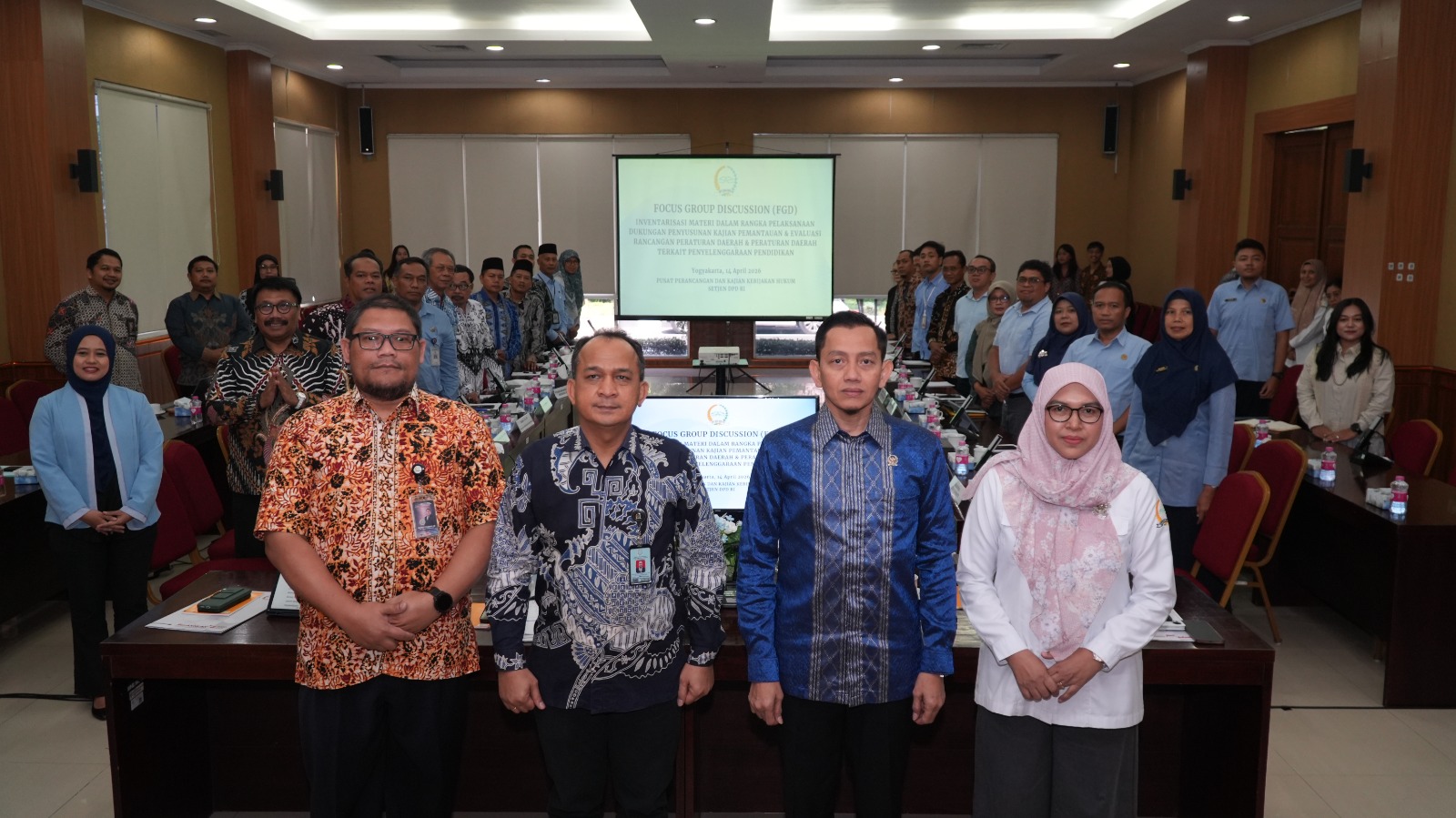
Yogyakarta, dpd.go.id – Ahmad Syauqi Soeratno, a member of the House of Regional Representatives of the Republic of Indonesia (DPD RI) representing Special Region of Yogyakarta (DIY) Province and Chairperson of the DPD RI Public Accountability Board, emphasized the critical need for regulatory synchronization to address fundamental education challenges in the regions. This was stated during a Focus Group Discussion (FGD) titled "Inventory of Materials for Monitoring and Evaluating Draft Regional Regulations and Existing Regulations Related to Education Implementation," held at the DPD RI DIY Office on Tuesday (April 14).
The event was initiated by the Center for Policy dan Legal Studies (Pusperjakum) of the DPD RI Secretariat General. It aimed to gather factual data on various educational issues, ranging from regulatory disharmony between central and regional governments to the chaotic New Student Admission System or commonly known as SPMB and the operational hurdles faced by Community Schools.
In his keynote speech, Ahmad Syauqi Soeratno highlighted that regulation is the most crucial factor in shaping organizational culture. He warned that inaccuracies in drafting rules can have a systemic impact on the quality of educational output.
"One of the most powerful drivers of organizational culture in producing performance output is regulation. If we draft regulations incorrectly, the resulting culture will differ, the outputs will differ, and the outcomes will certainly differ," Syauqi stated.
Furthermore, Syauqi expressed concern over inaccurate poverty data, which directly affects students' rights to education through affirmative action tracks. He cited the disqualification of 139 prospective students during the 2025 SPMB in DIY as clear evidence of fragile data coordination between agencies.
Echoing these sentiments, the Head of Pusperjakum, Sanherif Sojuangon Hutagaol, explained that while basic education in Indonesia is nearly universal, quality varies significantly across provinces. He emphasized the role of the DPD RI in ensuring rules do not overlap. "The DPD RI, as a state organ with a constitutional mandate, monitors and evaluates regional regulations to ensure that education governance in the regions is harmonious, effective, and free of overlapping rules," Sanherif explained.
The FGD featured various cross-sectoral speakers. Constitutional Law Expert Hestu Cipto Handoyo stated that amidst technological disruption and the advancement of Artificial Intelligence (AI), education faces challenges in preserving values and character building. “There is a need for an integrative curriculum that combines values, culture, and technology, so that the utilization of such technology is value-based, rather than just for the sake of efficiency,” he emphasized.
Meanwhile, DIY Ombudsman Member Abdullah Abidin explained that school zoning remains the most frequent issue arising in DIY. The limited capacity of state schools is a recurring annual problem, while public interest in specific schools remains very high. “On the other hand, there is still a perception that school quality is not yet uniform, which encourages practices such as domicile manipulation. This indicates that the goal of equalizing education has not been fully achieved,” Abdullah explained.
Responding to the issues surrounding the New Student Admission System, a representative from the DIY Education, Youth, and Sports Agency (Disdikpora), Tukiman, stated that improvements to the system will continue. For the upcoming academic year, Disdikpora DIY will implement fundamental principles for the SPMB based on integrity, objectivity, fairness, transparency, non-discrimination, and accountability.
"A clean admission system is a shared responsibility: the government provides regulation and oversight, schools ensure honest implementation, and parents and the community must refrain from cheating while actively participating in monitoring," he explained.
Participants from the Provincial, District, and City Education Offices, the DIY Education Board, PGRI DIY (Teachers' Association), and representatives from public, private, and inclusive schools provided input and perspectives regarding the implementation of education in DIY. Several critical issues emerged, including teacher autonomy, budgetary fairness between private and public schools, and the integration of local wisdom specifically "Pendidikan Kejogjaan" (Yogyakarta-based education) into formal regulations.
The series of activities concluded with a field visit to Sekolah Rakyat Menengah Atas (SRMA) 19 Bantul, located in Sonosewu, Ngestiharjo, Kasihan, Bantul. The purpose of this visit was to observe firsthand the implementation of alternative education models for children from socio-economically vulnerable families, as well as to verify infrastructure constraints and operational permit statuses, which have long been key aspirations for non-formal education providers in the region.
The output from this material inventory and field visit will be compiled into preliminary policy recommendations for the Regional Legislation Committee (BULD) of the DPD RI. These recommendations aim to strengthen the quality of regional regulations and enhance the effectiveness of education implementation throughout the regions.
AGENDA KEGIATAN
DEWAN PERWAKILAN DAERAH REPUBLIK INDONESIA