Informasi Seputar Kegiatan di DPD RI
AGENDA KEGIATAN
DEWAN PERWAKILAN DAERAH REPUBLIK INDONESIA
25 July 2026 oleh admin
Jakarta, dpd.go.id – The proposed Archipelagic Regions Bill (RUU Daerah Kepulauan) is regarded as a crucial legal foundation for ensuring that Indonesia's development policies fully reflect its identity as the world's largest archipelagic nation. The bill seeks to shift the national development paradigm beyond a land-based perspective by recognizing Indonesia's unique geographical, social, economic, and maritime characteristics as key national strengths.
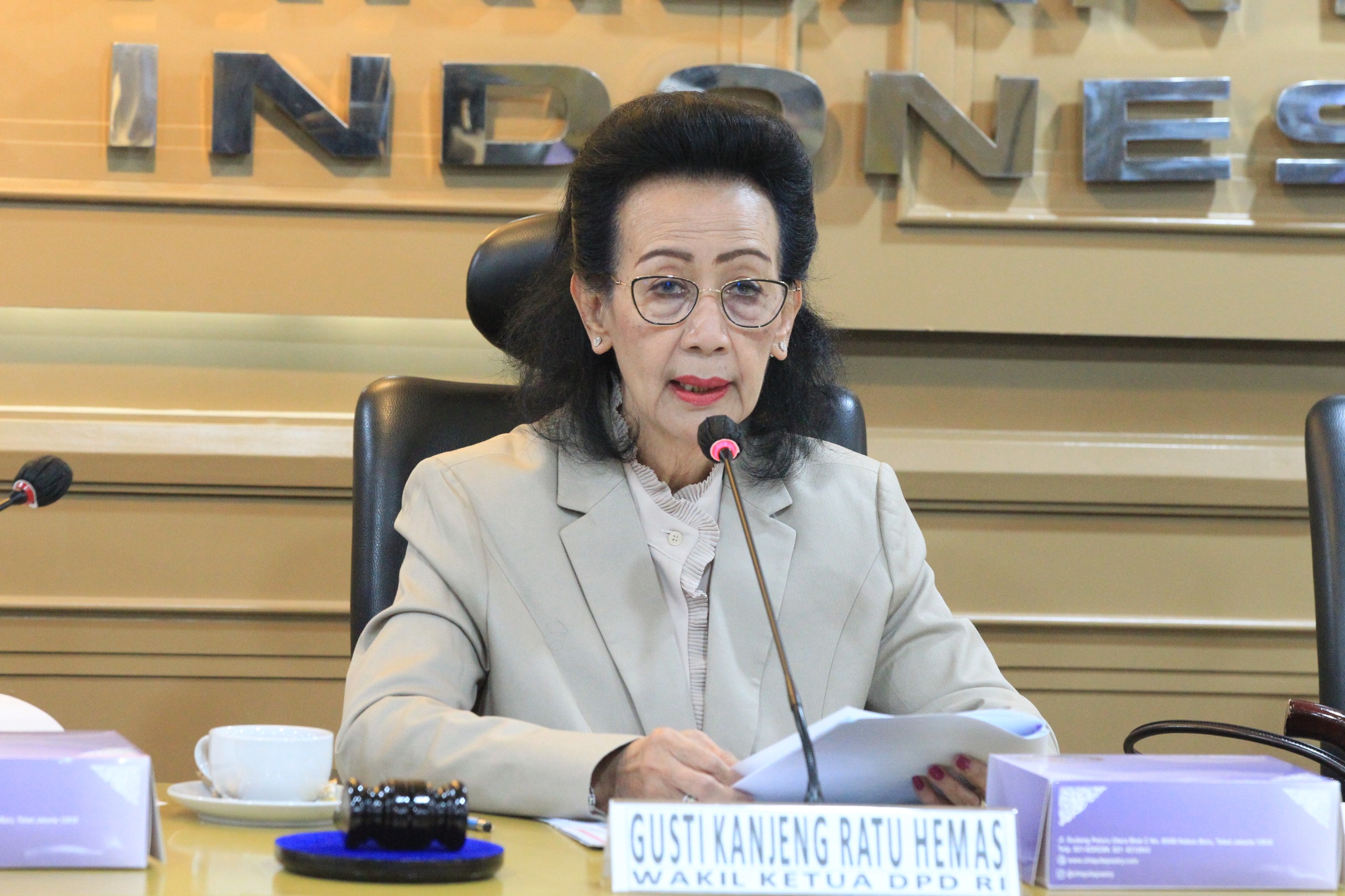
Vice Speaker of the House of Regional Representatives of The Republic of Indonesia (DPD RI), GKR Hemas, stated that Indonesia's status as an archipelagic state has been formally recognized under Article 25A of the 1945 Constitution and the 1982 United Nations Convention on the Law of the Sea (UNCLOS), ratified through Law No. 17 of 1985. However, she emphasized that this recognition must be translated into national development policies that genuinely reflect the needs and characteristics of Indonesia's island regions.
"As an archipelagic nation, Indonesia needs development policies that embody this identity. Recognition as an archipelagic state should not remain merely a constitutional or geographical concept, but must become the foundation for formulating national development policies," said GKR Hemas, who also serves as Chairperson of the DPD RI Working Team on the Archipelagic Regions Bill.
She described the bill as a strategic step toward ensuring continuity in Indonesia's national development agenda. Once enacted, it is expected to provide a cross-sectoral framework that enables ministries, government agencies, and regional administrations to adopt a unified approach to developing Indonesia's archipelagic regions.
"The Archipelagic Regions Bill is not merely about regulating island regions; it introduces a new development paradigm for shaping national policy. It will help ensure that development is no longer fragmented by sector, but integrated to promote equitable growth and improve the welfare of communities across Indonesia's archipelago," she said.
Echoing this view, R. Graal Taliawo, Vice Chairperson of the DPD RI Working Team on the Archipelagic Regions Bill and a senator representing North Maluku, said the legislation presents an important opportunity to synchronize policies that are currently scattered across various laws and regulations.
According to Graal, while numerous regulations already address maritime affairs and regional governance, they have yet to be integrated into a single framework specifically designed for the development of Indonesia's archipelagic regions.
"The Archipelagic Regions Bill is intended to bring together policies that have long operated independently. Through a comprehensive legal framework, development in archipelagic regions can be planned more strategically, systematically, and sustainably," he said.
Graal further explained that the development of island regions requires a policy approach that views the sea not only as a body of water but also as a living space, an economic asset, and a vital connector between islands. Consequently, development policies should integrate public services, local economic development, environmental protection, and efforts to strengthen the competitiveness of Indonesia's island regions.
"When the sea is recognized as a space that connects communities and regions, development policies must also be designed from the perspective of inter-island connectivity. This is the approach we seek to strengthen through the Archipelagic Regions Bill so that development truly reaches every part of Indonesia," he said.
The DPD RI expressed hope that deliberations on the Archipelagic Regions Bill can be concluded promptly in cooperation with the House of Representatives (DPR RI) and the Government. The legislation is expected to provide Indonesia with a comprehensive legal framework for achieving equitable development across its archipelagic regions while reinforcing the nation's vision as a sovereign, advanced, and prosperous archipelagic state.
AGENDA KEGIATAN
DEWAN PERWAKILAN DAERAH REPUBLIK INDONESIA