Informasi Seputar Kegiatan di DPD RI
AGENDA KEGIATAN
DEWAN PERWAKILAN DAERAH REPUBLIK INDONESIA
24 August 2026 oleh admin
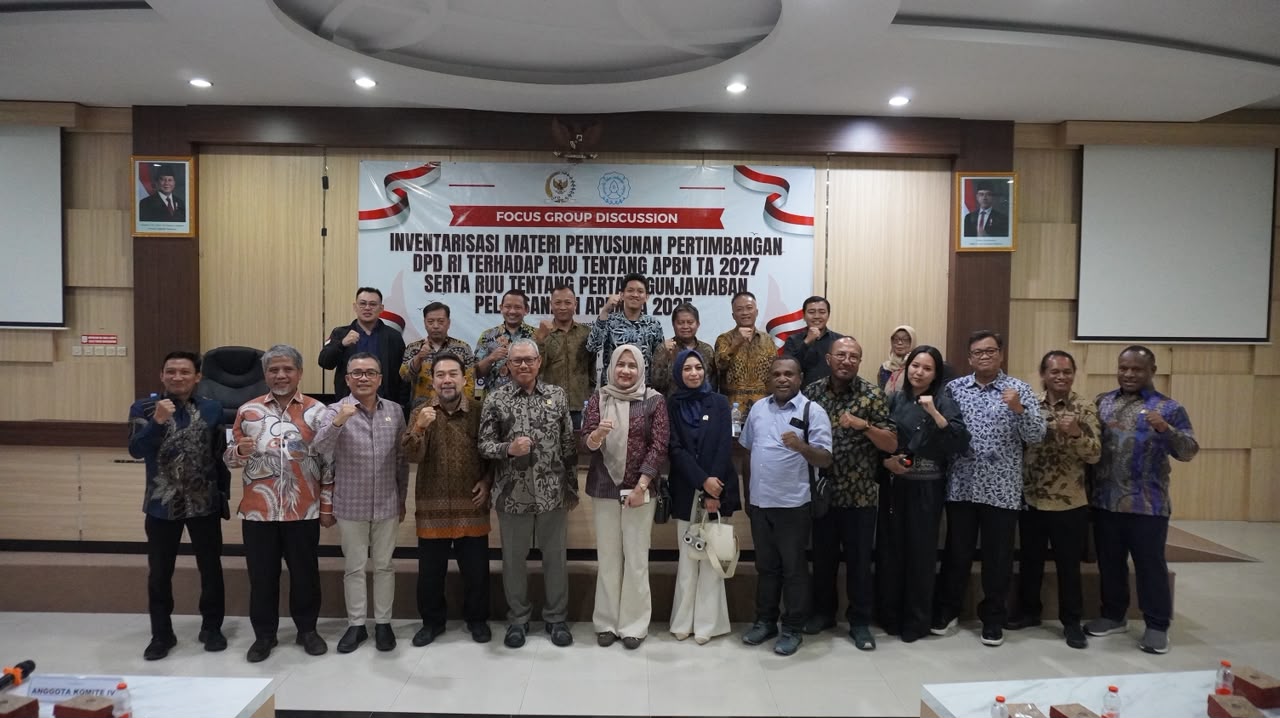
Surakarta, dpd.go.id – Committee IV of the House of Regional Representatives of the Republic of Indonesia (DPD RI) gathered various academic and empirical inputs from Universitas Sebelas Maret (UNS) in Surakarta, Central Java, as material for formulating the DPD RI’s considerations on the Draft Law on the 2027 State Budget (APBN) and the Draft Law on Accountability for the Implementation of the 2025 State Budget.
The input was collected through a Focus Group Discussion (FGD) held by Committee IV of the DPD RI with academics, local government officials, and economic experts at the Faculty of Economics and Business of UNS on Saturday (August 22, 2026).
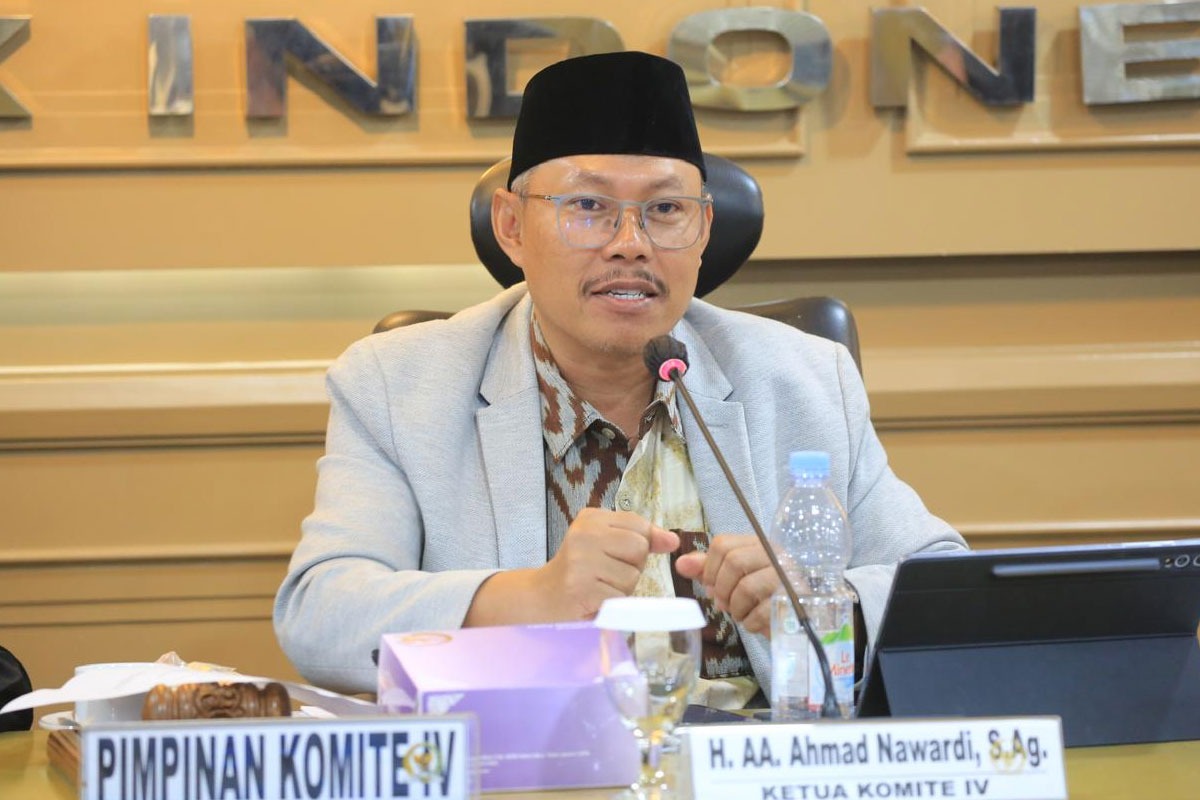
Chairperson of Committee IV of the DPD RI H. Ahmad Nawardi said the FGD was part of the DPD RI’s constitutional mandate to provide considerations to the House of Representatives (DPR RI) regarding the Draft Law on the State Budget and the Draft Law on Accountability for the Implementation of the State Budget.
“We want to ensure that national fiscal policy is not only credible from a macroeconomic perspective, but also genuinely addresses regional needs. Therefore, the voices of academics and local governments are essential in formulating the DPD RI’s considerations for the 2027 State Budget Draft,” Ahmad Nawardi said.
According to him, the State Budget must serve as an instrument for equitable development while strengthening regional fiscal capacity. He said that an increase in Transfers to Regions (TKD) should be accompanied by a more targeted allocation design that provides regions with adequate fiscal space.
The 2027 State Budget Draft, presented by the President of the Republic of Indonesia at the Joint Session of the DPR RI and DPD RI on August 14, 2026, carries the theme “Higher Growth, Faster Prosperity.” The government has set a state revenue target of Rp3,426.0 trillion, state expenditure of Rp4,097.2 trillion, and a deficit of Rp671.2 trillion, equivalent to 2.40 percent of GDP.
Meanwhile, the allocation for Transfers to Regions (TKD) has been set at Rp735.0 trillion, an increase from the 2026 realization outlook of Rp696.9 trillion.
“The increase in the nominal TKD allocation is certainly positive, but what is equally important is how the funds are allocated and spent. Regions should not receive additional funding while their fiscal space remains limited and the quality of spending has yet to improve,” Ahmad said.
Push for TKD Reformulation and Stronger Fiscal Independence
During the FGD, Yogi Pasca Pratama, Head of the Village Development Laboratory at the Faculty of Economics and Business of UNS, highlighted the importance of optimizing the 2027 TKD allocation to promote fiscal independence and public welfare in the regions. He called for simpler technical guidelines for the distribution of the Special Allocation Fund (DAK) to prevent funds from accumulating due to local governments’ limited capacity to absorb budget allocations.
“What needs to be improved is not only the amount of TKD, but also the design and distribution mechanisms. Simplifying the technical guidelines is important so that budget allocations can be more quickly translated into programs and tangible benefits for the public,” Yogi said.
He also warned of several regional fiscal risks, including potential regional deficits and debt, as well as pressure on regional revenues during the transition to the motor vehicle tax surcharge policy in early 2027.
Among the recommendations presented were the reformulation of variables for the Revenue Sharing Fund from Natural Resources, affirmative DAK allocations for archipelagic regions and underdeveloped, frontier, and outermost (3T) regions, as well as fiscal incentives for regions demonstrating strong performance.
Java’s Development Needs Greater Integration
Meanwhile, Lukman Hakim of the Faculty of Economics and Business of UNS, together with the Central Java Provincial Development Planning Agency (Bappeda), highlighted the importance of synchronizing development planning across Java.
Issues discussed included strengthening the southern corridor of Central Java, improving the Solo–Semarang railway connectivity, developing the Jragung and Bener dams, and promoting tourism and agro-industry to support food security and equitable economic growth.
Lukman also highlighted changes in Indonesia’s economic structure, which indicate a trend toward deindustrialization. The contribution of the manufacturing sector to the economy has reportedly declined from 28.4 percent in 2005 to 19.9 percent in 2025, while the services sector has reached 44.8 percent.
“Downstreaming must not stop at processing activities in downstream sectors. We need to ensure that upstream sectors, manufacturing, technology, and export capacity are also strengthened so that economic transformation generates greater added value for Indonesia,” Lukman explained.
He also emphasized the importance of deepening the national financial sector. Indonesia’s M2-to-GDP ratio, which stood at around 42.5 percent in 2025, was considered relatively low compared with several countries in the region and China.
“Financial deepening is important because it is directly related to the economy’s ability to provide financing for investment, businesses, and development,” he said.
In terms of the growth structure, Indonesia’s economy remains heavily supported by consumption, which accounts for more than 50 percent, while investment contributes around 30 percent and exports around 17 percent. Therefore, future economic policies are considered necessary to more aggressively strengthen investment, productivity, exports, and industrial capacity.
2027 State Budget Draft Must Strengthen Investment and Regional Economies
Chief Economist of The Indonesia Economic Intelligence (IEI), Sunarsip, discussed the macroeconomic outlook and fiscal challenges facing the 2027 State Budget Draft.
Sunarsip noted that S&P Global Ratings has maintained Indonesia’s credit rating at BBB with a stable outlook. However, he warned of challenges stemming from the dominance of consumption-oriented spending, which could reduce fiscal room for capital expenditure and government investment.
“Our fiscal challenge going forward is to maintain fiscal credibility while ensuring that government spending becomes increasingly productive. Fiscal space must be directed toward promoting investment, productivity, and sustainable economic growth,” Sunarsip said.
He also highlighted China’s reform experience involving state-owned enterprises (SOEs), particularly the establishment of the State-owned Assets Supervision and Administration Commission (SASAC), as a potential lesson for strengthening investment governance and dividend policy discipline.
During the discussion, fiscal policy was also examined from the comparative perspectives of SBYnomics, Jokowinomics, and Prabowonomics, particularly in relation to shifts in subsidy and development spending priorities.
Sunarsip emphasized the importance of strengthening incentive systems for farmers and micro, small, and medium enterprises (MSMEs) amid challenges related to food and energy security.
“In addition to downstreaming, we must also pay attention to upstream sectors, manufacturing, farmers, and MSMEs. Food and energy security will not be strong if the production base is not strengthened,” he said.
Strengthening the Solo Raya Economy Based on Regional Potential
The FGD also examined the economic characteristics of the Solo Raya or Subosukawonosraten region. Based on 2025 Gross Regional Domestic Product (GRDP) data, the average contribution of the services sector in the region reached 47.9 percent, industry 38.4 percent, and agriculture 13.7 percent.
These figures show that the services sector remains one of Solo Raya’s key strengths. Therefore, policy measures are needed to strengthen service-, industry-, trade-, and region-specific leading-sector-based agglomeration.
Regional development should also take into account the economic characteristics of each area in Central Java. Subosukawonosraten, for example, has potential in the textile industry and trade services; Kedungsepur in fisheries and light industry; Barlingmascakeb and Kedu Raya in agriculture and plantations; Pati Raya in the food and beverage industry; and Tegal Raya in automotive components and spare parts.
The forum also highlighted the importance of greater attention to the clothing sector as part of people’s basic needs. ISEI Solo called for stronger institutional attention to the sector, alongside food security and housing development.
Ten Topics and Four Key Outputs
Overall, the FGD addressed ten main topics, consisting of eight topics related to the 2027 State Budget Draft and two topics evaluating the implementation of the 2025 State Budget.
The discussions covered the credibility of macroeconomic assumptions, the balance between state revenues and expenditures, the design of TKD, national development priorities, synchronization of development across Java, mitigation of regional fiscal risks, support for higher education and research, and the strengthening of the people’s economy through the Merah Putih Village and Urban Village Cooperatives. Meanwhile, the evaluation of the 2025 State Budget covered economic growth, the fiscal deficit, as well as the effectiveness of TKD distribution and absorption.
Based on the audited 2025 Government Financial Report (LKPP), economic growth stood at 5.11 percent, slightly below the State Budget target of 5.2 percent, with the realized deficit reaching 2.81 percent of GDP. Meanwhile, realized Transfers to Regions spending amounted to Rp849.04 trillion, or 92.30 percent of the budget ceiling.
Ahmad Nawardi emphasized that all input gathered during the FGD would be consolidated into official material for Committee IV of the DPD RI.
“We do not want the FGD to end as merely a discussion forum. We will bring all of these inputs into the formulation of the DPD RI’s official considerations, ensuring that regional perspectives are genuinely reflected in discussions on the 2027 State Budget and the evaluation of the 2025 State Budget,” he stressed.
Through the FGD, Committee IV of the DPD RI is targeting four key outputs: the preparation of an Inventory of Problems (DIM) for the 2027 State Budget Draft and the implementation of the 2025 State Budget from a regional perspective; the formulation of considerations on the Draft Law on the 2027 State Budget; the formulation of considerations on the Draft Law on Accountability for the Implementation of the 2025 State Budget; and recommendations for synchronizing State Budget, TKD, and Regional Budget (APBD) policies while strengthening development financing for Central Java.
According to Ahmad, optimizing TKD in 2027 is ultimately not merely a matter of increasing the budget, but of ensuring that every rupiah allocated generates tangible benefits for the public.
“The success of TKD should not be measured solely by the size of the budget, but by how accurately it is allocated, how effectively it is spent, and how significant its impact is on regional fiscal independence and public welfare,” Ahmad concluded.
All academic and empirical inputs from academics, local governments, and economic practitioners will subsequently serve as material for the formulation of Committee IV of the DPD RI’s official considerations before being submitted for approval at the DPD RI’s Extraordinary Plenary Session.
AGENDA KEGIATAN
DEWAN PERWAKILAN DAERAH REPUBLIK INDONESIA