Informasi Seputar Kegiatan di DPD RI
AGENDA KEGIATAN
DEWAN PERWAKILAN DAERAH REPUBLIK INDONESIA
15 August 2026 oleh admin
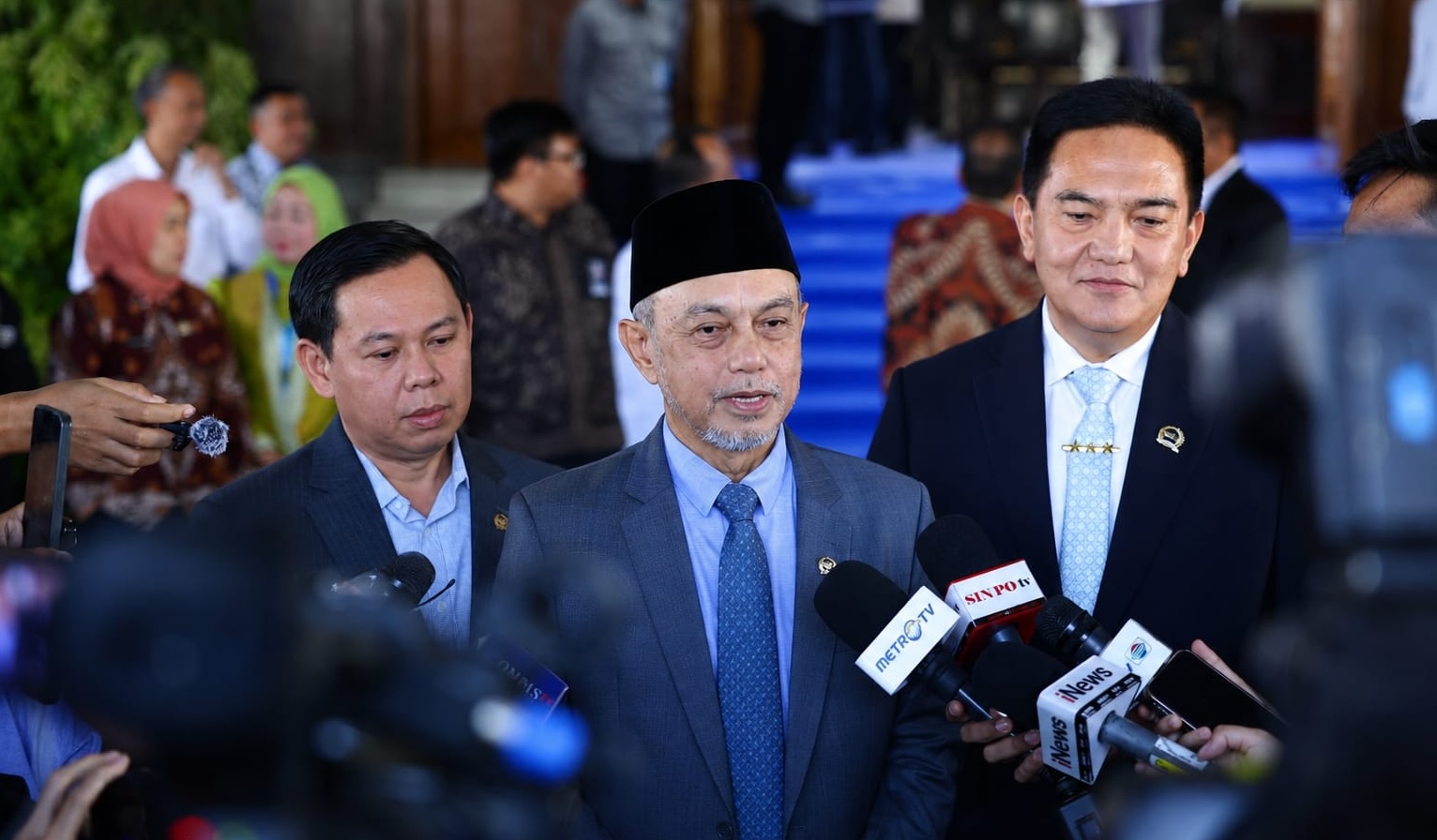
Jakarta, dpd.go.id — Vice Speaker of the House of Regional Representatives of the Republic of Indonesia (DPD RI) Tamsil Linrung said President Prabowo Subianto’s State of the Nation Address reaffirmed a new direction for Indonesia’s development, namely national self-reliance that goes beyond economic growth to generate a chain of positive impacts on public welfare. Tamsil said the national policy direction has a strong constitutional foundation in Article 33 of the 1945 Constitution and is translated into policy through the State Budget (APBN). He described this as the “Asta Cita Welfare Spiral,” referring to a series of policies that move forward simultaneously and reinforce one another.
“I interpret one major message from the President’s address: Indonesia is moving simultaneously across various sectors toward self-reliance. This creates a chain reaction,” Tamsil said at the Parliament Complex in Senayan on Friday (August 14).
According to Tamsil, efforts to build national self-reliance are part of a global trend occurring in various parts of the world, not only in developing countries but also in developed nations. This trend has been driven by global vulnerabilities arising from geopolitical tensions, disruptions to supply chains, and economic uncertainty.
Tamsil particularly commended the government’s achievement in attaining food self-sufficiency. In his view, the most fundamental measure of a nation’s self-reliance lies in its ability to meet its own food needs.
“A nation that cannot feed its own people will always depend on other nations. Therefore, food self-sufficiency is not merely an ordinary agricultural policy. It is an expression of a political strategy for national sovereignty,” he added.
Tamsil said the meaning of self-reliance goes much deeper. In his view, the self-reliance agenda conveyed by the President is directly linked to the mandate of Article 33 of the 1945 Constitution, which places the national economy within a framework that prioritizes the people’s interests through state control over national resources.
“What is particularly interesting about President Prabowo’s policy direction is the effort to bring the spirit of Article 33 from the constitutional text into economic policy. Food self-sufficiency, downstream industrialization, state asset management, and the strengthening of cooperatives and the people’s economy must all be understood within this framework,” Tamsil said.
He stressed that Article 33 must not remain merely a constitutional provision discussed in constitutional law textbooks. It must serve as a guiding principle in designing economic policies and the state budget.
“The President is recalibrating the nation’s direction after we have been looking the other way for too long. Article 33 must live as the spirit behind our policies,” he stressed.
Tamsil said that amid changes in the global economic landscape, implementing Article 33 has become increasingly relevant. The state must have the capacity to safeguard national interests without stifling market dynamics.
“We are not building an anti-market economy. Markets remain important. But markets must be placed within an ecosystem that ensures the interests of the people and the national interest are not sacrificed,” he said.
In his address, the President outlined a number of government achievements in the food sector as well as developments in national economic growth. For Tamsil, however, what matters more than the figures themselves is whether such growth creates tangible benefits for society.
“We see the direction of government policy as pursuing economic growth that does not stop at statistics. It must generate momentum that benefits farmers, workers, businesses, and all segments of society,” said the senator from South Sulawesi.
As a former leader of the DPR RI Budget Committee, Tamsil said development cannot be achieved simply by establishing policies. Policies must be translated into budget designs capable of generating multiplier effects.
“The President’s Financial Note Speech is an important part of the same direction. If Article 33 is our economic compass, then the State Budget is the engine. This is where policies are translated into allocations that must generate a multiplier effect for the people,” Tamsil said.
He said every rupiah allocated through the State Budget must have leverage. It should not merely be absorbed, but must drive production, create jobs, increase purchasing power, strengthen regional economies, and ultimately improve public welfare.
“The State Budget must be assessed through a new paradigm. It should not be measured merely by how much is spent or how high the budget absorption rate is. What is far more essential is the economic value and social benefits generated by every rupiah spent,” he stressed.
According to Tamsil, the state budget must serve as an instrument for transforming the direction of development. He illustrated that spending on food should not stop at ensuring the availability of food supplies.
“If food spending only produces rice, its impact is limited. But if food spending increases farmers’ production, creates jobs, and boosts people’s purchasing power, then one rupiah of budget spending has created multiple layers of economic value,” he said.
Therefore, Tamsil believes government policies across various sectors must be viewed as part of an interconnected chain that reinforces one another. Food self-sufficiency strengthens production. Downstream industrialization creates added value. Reform and consolidation of state-owned enterprises (SOEs) improve the efficiency of state assets. Strengthening cooperatives expands economic access for the people. All of these efforts must ultimately lead to greater public welfare.
“This is the spiral. Policies do not operate independently; instead, they create momentum for other policies,” he said.
Tamsil also praised the government’s efforts to undertake institutional transformation and reform of state-owned enterprises. The President stated that within 21 months, the government had introduced 121 transformative policies and consolidated around 250 SOE entities through Danantara, with savings reportedly reaching approximately Rp50 trillion. According to Tamsil, while the figures are important, the substance of the reform is far more significant.
“What we need is not merely to reduce the number of companies. More importantly, we need to eliminate overlapping structures, reduce bureaucratic costs, and ensure that state assets work more productively for the people,” he said.
Tamsil stressed that state assets must not merely exist as figures on financial statements. They must generate added value for the state and the people. He said SOE reform must be positioned as part of the broader agenda to increase national economic productivity.
Tamsil added that national development cannot be carried out by the central government alone. Therefore, he views collaborative politics as an important element in achieving the Asta Cita agenda.
“Asta Cita will not become a spiral if every sector operates independently. The central government, regional governments, parliament, businesses, cooperatives, and society must move together as one development orchestra,” he said.
According to Tamsil, politics must not stop at competing interests. Politics must evolve toward building common ground so that development agendas concerning the public interest can be pursued collectively.
“Our task is also to build solidarity and collaboration, so that good policies can be implemented together and their benefits reach the people,” he said.
He said the DPD RI plays an important role because the success of national development must ultimately be measured by what happens in the regions.
“From the DPD’s perspective, we see the State Budget not merely as a fiscal document of the central government. It is an instrument for equitable development. Its impact must be visible in the regions.”
Tamsil emphasized the importance of solidarity between the central and regional governments, between the government and parliament, and between businesses and society. Development can only be strong when these interests are connected.
Tamsil stressed that Asta Cita should not be viewed as a collection of standalone programs. Rather, it should be understood as an integrated development architecture in which various policies reinforce one another, particularly through an emphasis on the national interest, which the President has increasingly highlighted through the implementation of Article 33 of the 1945 Constitution.
Tamsil concluded by emphasizing that the direction toward national self-reliance outlined by the President must be maintained and jointly safeguarded.
AGENDA KEGIATAN
DEWAN PERWAKILAN DAERAH REPUBLIK INDONESIA