Informasi Seputar Kegiatan di DPD RI
AGENDA KEGIATAN
DEWAN PERWAKILAN DAERAH REPUBLIK INDONESIA
19 September 2026 oleh admin
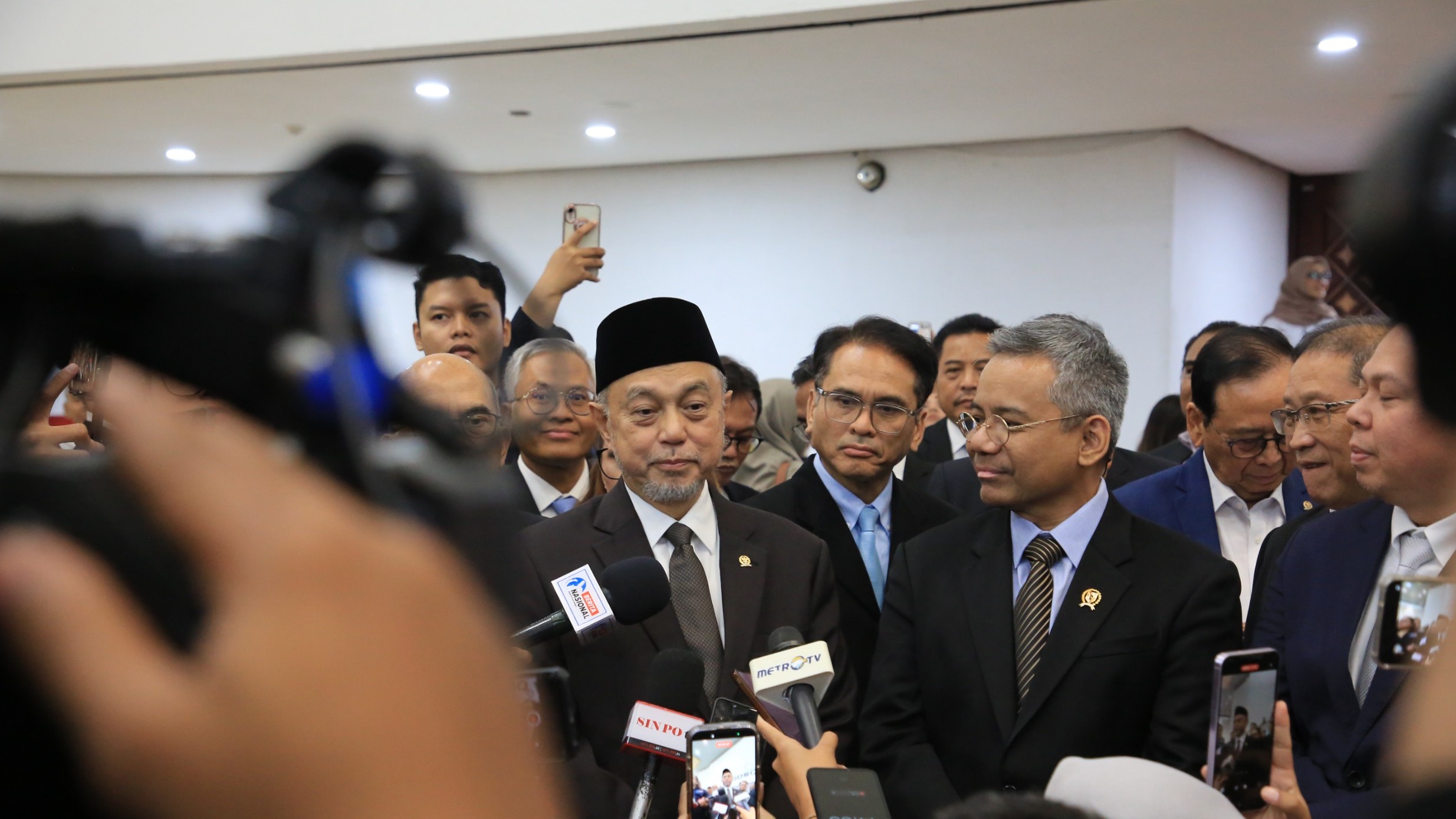
Jakarta, dpd.go.id — The submission of the House of Regional Representatives of the Republic of Indonesia (DPD RI) Considerations on the Draft State Budget Bill (RUU APBN) for Fiscal Year 2027 marks a crucial momentum in reinforcing central-regional financial architecture. Vice Speaker of the DPD RI Tamsil Linrung warmly welcomed the inauguration of the new Minister of Finance, Suahasil Nazara. He presented a technocratic breakthrough in the form of a fiscal-neutral budget reallocation worth IDR 45.22 trillion to strengthen Transfers to Regions (TKD) without altering the state budget deficit.
During the DPD RI Plenary Session, attended by the Minister of Finance, the Head of Bappenas, and the Chairman of the Financial Services Authority (OJK), Tamsil emphasized that the new Finance Minister's track record and commitment to fiscal discipline offer a beacon of hope for regions that have recently been "gasping for air" due to cuts in transfer allocations.
"We place great optimism in the new captain of the Ministry of Finance. Mr. Suahasil has a long track record; he is a highly capable fiscal architect. We hope he can weave budget equity from Sabang to Merauke," Tamsil stated in a press release in Jakarta.
The former leader of the DPR Budget Committee painted a grim picture of fiscal decentralization, which has steadily eroded over time. The share of Transfers to Regions (TKD) relative to total State Expenditure dropped from 28.24% in 2023 and faces a further contraction to just 17.94% in the 2027 Draft State Budget (RAPBN). At the same time, debt interest payments have surged to IDR 650.31 trillion—a staggering figure that nearly rivals the entire national TKD allocation of IDR 735.00 trillion. An imbalance has emerged where Central Government Expenditure sits at the upper limit of the Government Work Plan (RKP) corridor at 12.02% of GDP, whereas TKD has been pushed down near the lower limit at 2.63% of GDP.
"When regional financial lifelines are constricted, local governments are forced to squeeze every bit of local tax and levy potential just to survive. This creates real pressure that triggers social unrest at the grassroots level. The burden accumulates on regional shoulders, yet the political risk falls heavily on the Central Government," Tamsil asserted.
In response to the bitter cries of the regions, the DPD offers a fiscally neutral reallocation scheme. The DPD urges that the Transfers to Regions (TKD) allocation be increased to IDR 780.22 trillion—equivalent to 2.79% of GDP—to reach the upper boundary of the 2027 Government Work Plan (RKP) corridor. This fresh IDR 45.22 trillion allocation would not be funded through new debt or a higher deficit, but rather by trimming approximately 7.33% from the Central Government's Other Expenditures Management Program (BA 999.08)—a pool totaling IDR 616.77 trillion that currently sits idle primarily as contingency funds.
This strategy is purely a realignment of budgetary breathing room without breaching fiscal discipline. Total State Expenditure remains anchored at IDR 4,097.19 trillion, the deficit target does not shift from 2.40% of GDP, and no new debt is incurred. It is pure reallocation," Tamsil explained.
In its recommendation document, the DPD RI itemized the distribution of these additional funds to mend developmental divides across the regions. IDR 20.00 trillion injected into Revenue Sharing Funds (DBH) to untangle underpayment backlogs and restore the financial rights of resource-producing regions. IDR 15.00 trillion allocated to revive Physical Special Allocation Funds (DAK Fisik)—which had plummeted to just IDR 5.00 trillion—to restart repairs on roads, irrigation networks, school facilities, and community health centers (puskesmas).
Meanwhile, Regular Village Funds (Dana Desa) are increased by IDR 5.00 trillion to IDR 30.00 trillion to safeguard village autonomy against centralized mandates. The remaining allocation is split to strengthen Fiscal Incentive Funds by IDR 2.00 trillion for high-performing regions, alongside IDR 3.22 trillion as an affirmative cushion for frontier, outermost, and underdeveloped (3T) areas, island territories, border zones, new autonomous regions, and disaster-affected areas.
Tamsil, often dubbed a budget maestro, emphasized the need to revisit key provisions in the 2027 Draft State Budget Bill (RUU APBN). This includes removing the Elucidation of Article 18, Paragraph (1) which is seen as eroding the windfall Revenue Sharing Fund (DBH) rights of resource-producing regions during commodity booms and revising Article 12, Paragraph (2) to ensure DPD RI aspirations are accommodated in physical DAK allocations.On the other hand, the presence of Bappenas and OJK was viewed as a golden opportunity to establish a tripartite synergy. Bappenas was urged to ensure macro targets, such as poverty reduction and farmer-fisherman welfare, are supported by sufficient regional budgets. Concurrently, OJK and the Ministry of Finance must mitigate the impact of aggressive high-yield Government Securities (SBN yielding 6.9%) issuances to prevent draining commercial bank liquidity and suffocating MSME credit lifelines in the regions.
National development must not hobble along unbalanced. The Ministry of Finance, Bappenas, and OJK must dance to the same beat. We cannot allow central government debt instruments to discourage regional banks from extending credit to the real economy," the former legislator emphasized.
The DPD RI is committed to championing these four recommendation pillars in joint 2027 State Budget deliberations alongside the DPR and the Government: a IDR 45.22 trillion fiscal-neutral reallocation, the restoration of Physical DAK and Village Funds, the protection of resource-producing regional rights, and the prevention of crowding-out effects in regional financing.
"Indonesia can accelerate its growth when regional administrations have adequate space to maneuver. Regional fiscal resilience is the key to achieving equitable development," Tamsil concluded.
AGENDA KEGIATAN
DEWAN PERWAKILAN DAERAH REPUBLIK INDONESIA