Informasi Seputar Kegiatan di DPD RI
AGENDA KEGIATAN
DEWAN PERWAKILAN DAERAH REPUBLIK INDONESIA
18 September 2026 oleh admin
Jakarta, dpd.go.id – The House of Regional Representatives of the Republic of Indonesia (DPD RI) is reinforcing the Archipelagic Regions Bill (RUU Daerah Kepulauan) as a legislative tool to bring an end to the disparities and injustices still experienced by island communities. Specific regulatory frameworks are required so that citizens' rights are no longer constrained by geographical distance, isolation, or limited access to basic services, legal protections, education, healthcare, and protections for women and children.
DPD RI member from Riau Islands, Ismeth Abdullah, stated that input from the National Commission on Human Rights (Komnas HAM), the National Commission on Violence Against Women (Komnas Perempuan), and the Indonesian Child Protection Commission (KPAI) reinforces the urgency of the Archipelagic Regions Bill. According to him, the issues facing island dwellers demonstrate that developmental lag is not merely about physical infrastructure, but fundamental human rights.
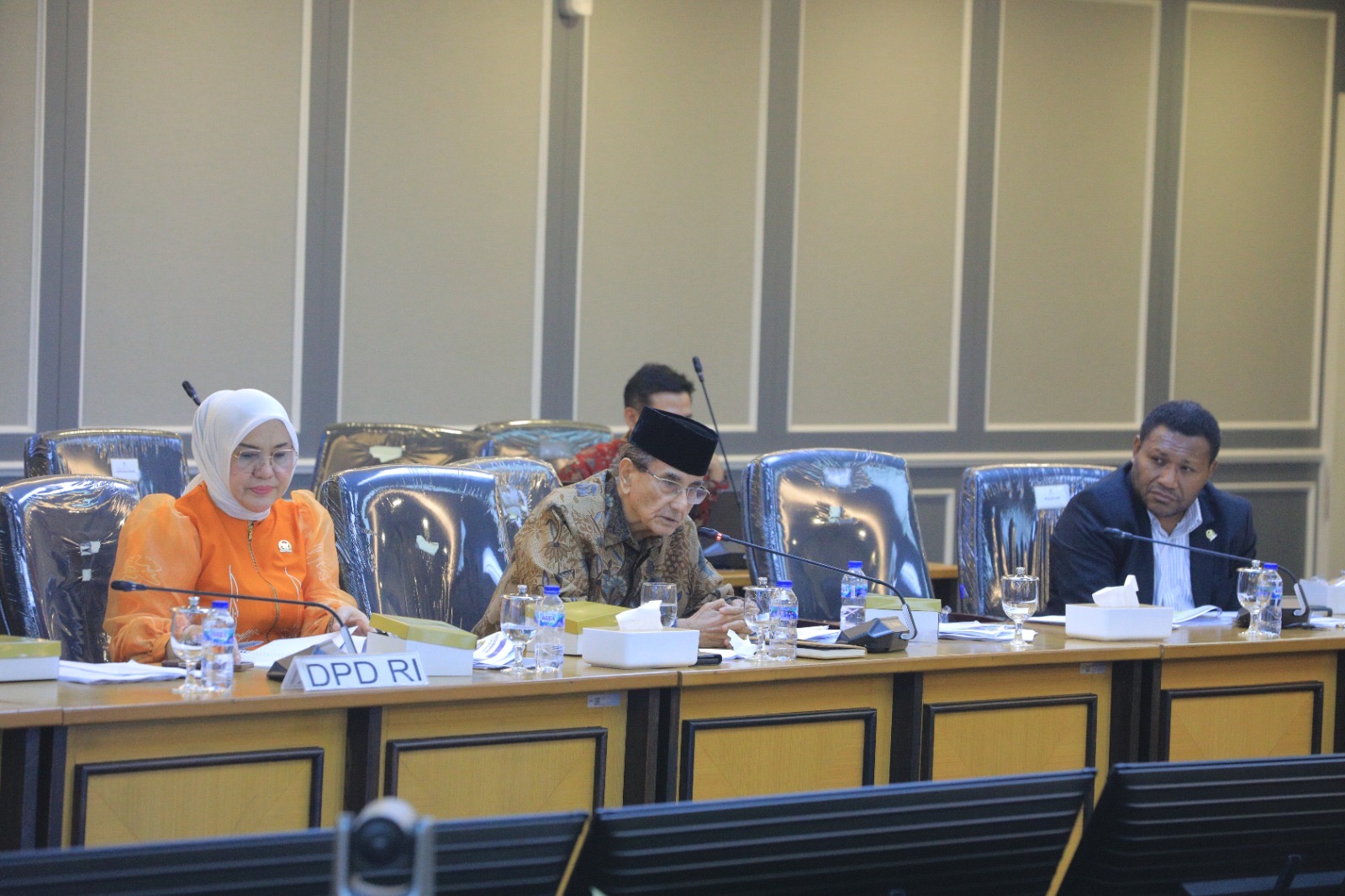
"The input provided is extraordinary, and we express our deepest gratitude. The information and feedback submitted will bolster our efforts to push this bill into law," Ismeth said during a Hearing of the DPR RI Special Committee (Pansus) on Regional Islands alongside Komnas HAM, Komnas Perempuan, and KPAI at the Parliament Building in Jakarta on Thursday (Sept 17, 2026).
He cited the ongoing challenges regarding civil administration and legal identity faced by residents in several island regions. During a recess period on an island in Lingga Regency, Ismeth encountered residents who were lawfully married according to religious rites in front of witnesses and family, yet lacked an official marriage certificate.
"It turns out they have been living without official marriage certificates. The marriages were valid under religious rites with witnesses present, but without documentation. That is still happening in regions, that is the reality of the lag across our island territories," he explained.
According to Ismeth, this gap is also evident in the condition of women, access to basic services, and connectivity across archipelagic areas, particularly in frontier, outermost, and underdeveloped (3T) regions. He stressed that island communities must receive adequate legal protections so they do not become subjects to power structures or policies that fail to account for their lived reality.
Ismeth touched on the situation in Rempang, Riau Islands, which he cited as an example demonstrating the necessity of legal safeguards for island dwellers. He asserted that regional economic development must not advance at the expense of leaving surrounding island populations behind.
"The saddest part, as noted by Komnas HAM, is precisely what we want to prevent in these regions: ensuring these communities are not rendered passive objects of power—power entering these islands where residents have no protection at all," he said.
Senator from Bengkulu, Leni Haryati John Latief, stated that women and children in island regions remain vulnerable due to gaps in facilities, infrastructure, and socio-economic conditions. Consequently, recommendations on protecting women and children must be incorporated directly into the text of the Archipelagic Regions Bill.
She highlighted the scarcity of support facilities for victims of violence, including a shortage of Regional Technical Implementation Units for the Protection of Women and Children (UPTD PPA) across multiple areas. The geography of archipelagic regions also necessitates easily accessible services for victims, including through mobile healthcare services and floating medical facilities.
"Most importantly, our goal is not environmental harm; we want to enhance community welfare while accounting for all these factors," Leni said.
DPD RI member from Papua, Carel Simon Petrus Suebu, noted that the Archipelagic Regions Bill must ensure affirmative action policies do not stop at administrative measures. Affirmative action, he stressed, must reach indigenous peoples, land rights, as well as coastal and island communities facing persistent land and resource conflicts.
Meanwhile, the Chairperson of Komnas HAM, Anis Hidayah, noted that Indonesia's historically mainland-oriented national development approach has created structural issues for island communities. Therefore, the Archipelagic Regions Bill should serve as a mechanism to guarantee human rights.
"National development that has historically favored mainland areas has created structural discrimination and spatial injustice for archipelagic and small-island communities. The Archipelagic Region Bill must serve as more than administrative governance, it must be a regulation anchored in the fulfillment of human rights," Anis stated.
The Chairperson of Komnas Perempuan, Maria Ulfah Anshor, commended the bill's deliberation as an effort to ensure justice and human rights for citizens in island regions. She noted that Komnas Perempuan has recommended since 2024 that the bill include explicit provisions on the prevention, response, and recovery support for women victims of violence.
"This bill is expected to ensure that affirmative policies for archipelagic regions truly reach those furthest from access, coastal women and small-island inhabitants," Maria said.
AGENDA KEGIATAN
DEWAN PERWAKILAN DAERAH REPUBLIK INDONESIA