Informasi Seputar Kegiatan di DPD RI
AGENDA KEGIATAN
DEWAN PERWAKILAN DAERAH REPUBLIK INDONESIA
06 October 2026 oleh admin
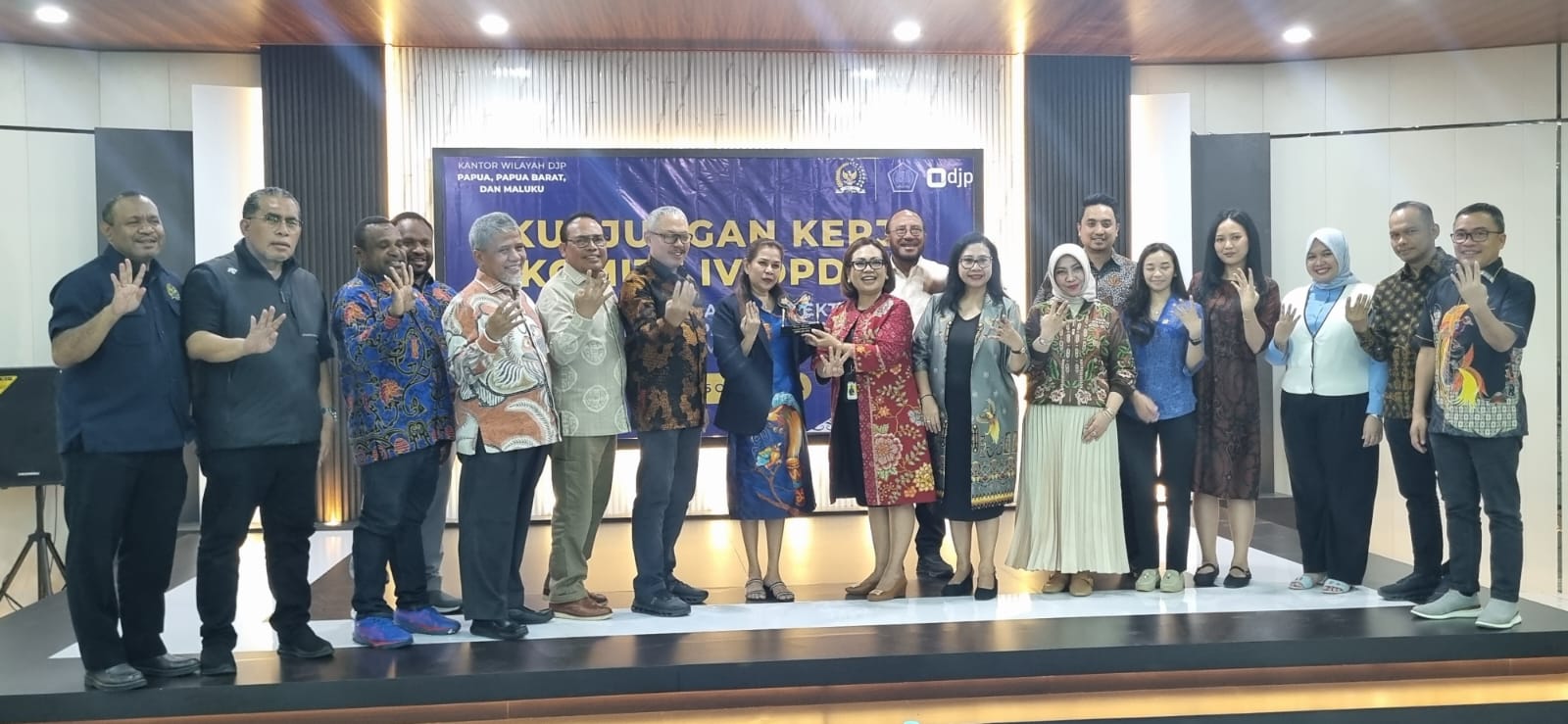
Jayapura, dpd.go.id — Committee IV of the House of the Regional Representatives of the Republic of Indonesia (DPD RI) conducted a working visit to coordinate efforts to strengthen strategic partners in implementing tax-related laws in Papua Province.
The working meeting was held at the Regional Office of the Directorate General of Taxes (DJP) for Papua, West Papua, and Maluku (Papabrama) in Jayapura. The delegation was received directly by Head of the Papabrama Regional Office, Ani Natalia, along with her officials.
Vice Chair of DPD RI Committee IV Novita Anakotta emphasized that the visit was part of the DPD RI’s constitutional mandate to oversee the implementation of laws, particularly those concerning regional interests.
According to Novita, Article 23A of the 1945 Constitution of the Republic of Indonesia stipulates that taxes and other compulsory levies imposed for state purposes must be regulated by law. Therefore, the implementation of tax laws must continue to be monitored to ensure that it is effective, fair, and accountable.
“Taxes are an important instrument for the state, but their implementation must also reflect a sense of fairness for the regions. We want to ensure that national tax policies can be implemented effectively without overlooking regional conditions and characteristics, particularly those of Papua,” Novita said.
The laws under Committee IV’s oversight include the Law on General Provisions and Tax Procedures (KUP), the Income Tax Law (PPh), and the Value Added Tax Law (PPN), all of which were most recently amended through the Harmonization of Tax Regulations Law (HPP Law). The HPP Law also serves as the legal basis for implementing the Coretax Administration System.
Novita explained that national tax revenue performance has shown a positive trend. As of the first half of 2026, tax revenue realization reached Rp1,035.7 trillion, or 43.9 percent of the state budget target of Rp2,357.7 trillion, representing 24.6 percent growth compared with the same period last year.
However, the achievement has not been evenly distributed. In Papua Province, domestic tax revenue realization as of the end of June 2026 stood at Rp1.71 trillion against a target of Rp5.73 trillion, equivalent to approximately 29.8 percent.
The nearly 14-percentage-point gap compared with the national average indicates that revenue growth has not been evenly felt across eastern Indonesia. Nevertheless, total state revenue in Papua during the same period reached Rp2.90 trillion, or 42.78 percent of the Rp6.7 trillion target.
“These figures must be viewed in their entirety. We do not want to assess Papua solely based on its tax revenue realization, but also consider the scale of Papua’s economic contribution to overall state revenue,” Novita stressed.
Meanwhile, in its presentation, the Papabrama Regional Office of the Directorate General of Taxes reported that net revenue as of September 30, 2026, had reached Rp4.88 trillion, or 59.76 percent of the Rp8.169 trillion target, with net growth of 13.89 percent. This placed the Papabrama Regional Office 32nd among 34 DJP regional offices nationwide.
The regional office explained that the achievement was influenced, among other factors, by a revenue structure heavily dependent on government spending and the trade sector, the vast and difficult-to-access geographical conditions, as well as economic activities in Papua whose tax administration is recorded outside the region.
Nevertheless, these conditions are not considered a reason to stop optimizing revenue. Through the end of the year, the Papabrama Regional Office will focus its efforts on data- and risk-based compliance monitoring, audits and tax collection, as well as strengthening coordination with regional governments.
Sectoral data presented during the meeting also drew the attention of DPD RI Committee IV. The Government Administration and Defense sector accounted for 56.99 percent of net revenue, far exceeding the Wholesale and Retail Trade sector, which contributed 12.03 percent. Meanwhile, the Financial and Insurance Activities sector recorded a 9.21 percent decline.
This composition indicates that Papua’s tax base remains heavily dependent on state and regional government spending rather than productive private-sector activities. This makes regional revenue vulnerable to fluctuations in government budget realization.
Therefore, expanding the tax base cannot be separated from efforts to promote private-sector economic growth, including among micro, small, and medium enterprises (MSMEs) and Indigenous Papuan entrepreneurs. The Papabrama Regional Office of the Directorate General of Taxes said it would prioritize education and assistance rather than simply increasing the number of registered taxpayers.
The centralization of Large Taxpayers was also highlighted by Committee IV. Since 2025, the tax obligations of PT Freeport Indonesia, one of Papua’s largest economic contributors, have been administered by the Large Taxpayer Office One in Jakarta.
The regional office acknowledged that under this arrangement, the amount of revenue recorded in Papua does not always correspond directly to the region’s actual economic contribution to state revenue.
“This is an important point for us. We must ensure that a region’s substantial economic contribution is not overlooked in regional revenue data simply because its tax administration is centralized elsewhere. We need more transparent data so that Papua’s actual contribution to the state can be reflected proportionately,” Novita said. In terms of implementation, the Papabrama Regional Office reported that 3,372 taxpayers had been reactivated as of September 30, 2026, exceeding the target of 1,920 taxpayers.
The annual tax return filing compliance rate among individual taxpayers reached 84.67 percent, while compliance among corporate taxpayers stood at only 37.43 percent. This gap highlights the need to strengthen guidance and supervision for incorporated businesses, which are expected to become one of the pillars of the private-sector tax base.
Regarding the implementation of Coretax, the regional office acknowledged that several challenges remain, particularly limited internet connectivity, unstable electricity supplies in remote areas, and varying levels of digital literacy among taxpayers in inland districts.
As mitigation measures, Tax Service Offices (KPP) and Tax Counseling, Consultation, and Services Offices (KP2KP) have established Coretax helpdesks, provided reporting assistance, and made services available outside their offices.
DPD RI Committee IV appreciated these measures. However, it stressed that assistance must go hand in hand with improvements in basic infrastructure.
“Digital transformation in taxation must not create new disparities. Coretax must make things easier for all taxpayers, including people living in remote areas. Therefore, tax digitalization must be accompanied by equal access to internet and electricity, as well as improved digital literacy,” Novita said.
The Papabrama Regional Office also conveyed three recommendations to central policymakers: strengthening digital connectivity, integrating and ensuring interoperability of data across government agencies, and strengthening local economies and MSMEs so that the tax base can grow alongside the private sector.
Committee IV views these three aspects as interconnected. Effective tax oversight requires accurate data; accurate data requires reliable digital infrastructure; and sustainable state revenue requires continued regional economic growth.
Based on these findings, DPD RI Committee IV will use the results of the working visit as material for overseeing the implementation of the KUP Law, Income Tax Law, VAT Law, and HPP Law, which will subsequently be submitted to the House of Representatives (DPR RI) for further action.
“The ultimate goal is not merely to pursue revenue figures, but to build a tax system that is fair, accountable, and capable of driving regional economic growth. Papua must have a proportionate place within the national taxation system, in accordance with its contribution and regional characteristics,” Novita concluded.
DPD RI Committee IV hopes that synergy and collaboration with the Ministry of Finance and its regional offices and agencies across Indonesia will continue to be strengthened so that tax policies at the regional level can be implemented more effectively, fairly, and accountably.
AGENDA KEGIATAN
DEWAN PERWAKILAN DAERAH REPUBLIK INDONESIA