Informasi Seputar Kegiatan di DPD RI
AGENDA KEGIATAN
DEWAN PERWAKILAN DAERAH REPUBLIK INDONESIA
10 September 2026 oleh admin
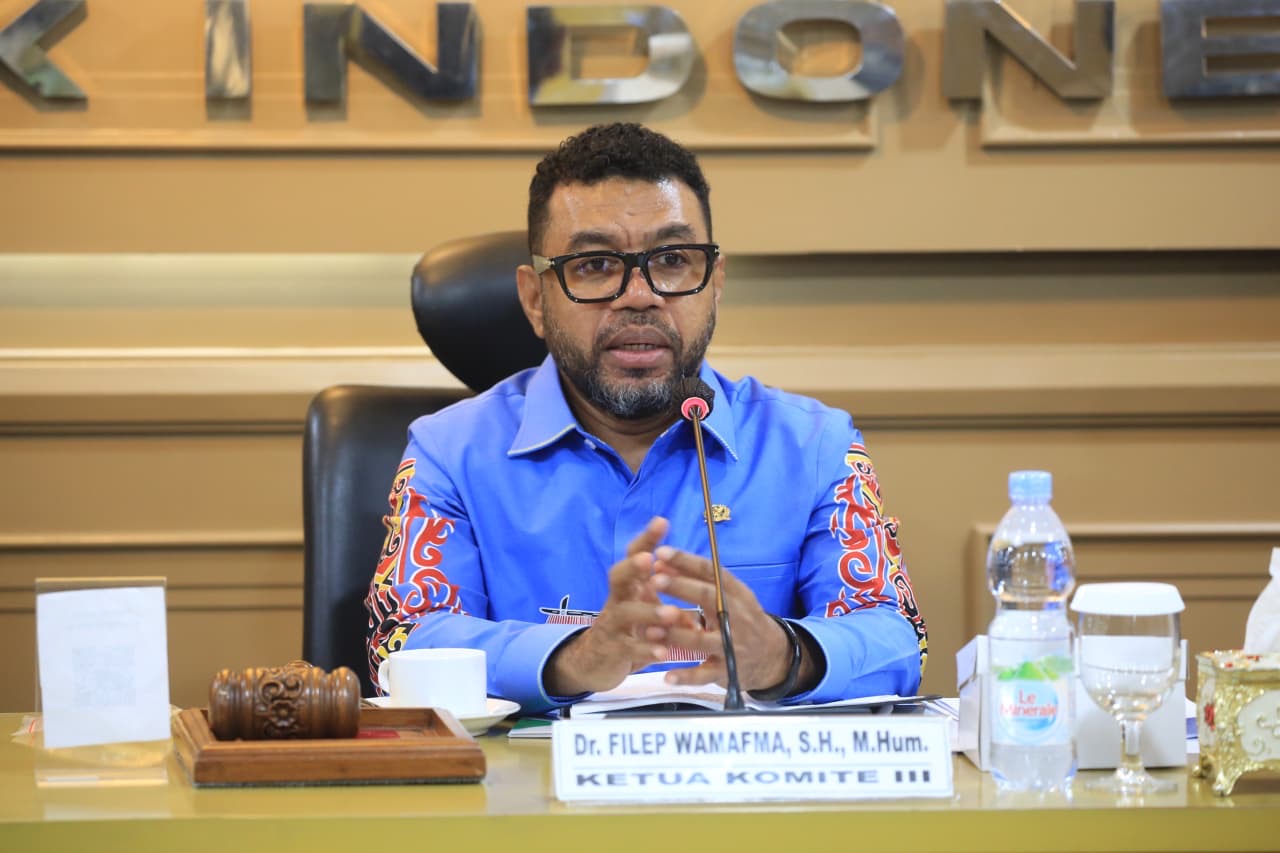
Jakarta, dpd.go.id – Chairperson of Committee III of the DPD RI, Dr. Filep Wamafma, expressed support for the government’s steps to strengthen the quality of the younger generation through higher education, technological mastery, research, and innovation as the foundation toward Golden Indonesia 2045 (Indonesia Emas 2045).
Filep emphasized that the higher education transformation agenda must be evenly distributed to all corners of the country, especially in 3T regions (Underdeveloped, Frontier, and Outermost). According to him, higher education institutions in regional areas require a stronger, more targeted, and equitable affirmative policy.
“We cannot use the same standards and formulas nationally, for example, comparing a university in Jakarta with one in mountainous regions, island areas, borders, and 3T regions. Economic, social, and geographical conditions must serve as key variables in national higher education policy,” Filep asserted on Thursday (10/9/2026).
This is because, the West Papua senator continued, disparities in access to higher education remain very evident. BPS (Central Bureau of Statistics) data shows that the national Gross Enrollment Ratio (Angka Partisipasi Kasar or APK) for higher education in 2025 stood at 32.89 percent, but the gap between regions is extremely wide. In Highland Papua, the higher education APK was only around 13.34 percent, Central Papua at 13.62 percent, South Papua at 24.15 percent, and West Papua at 27.99 percent.
“This issue is made more complex because regional higher education faces poverty and high geographical costs. In Central Papua, for example, the poverty rate in September 2025 reached 29.45 percent. Under these conditions, students do not only need tuition fees, but also funds for transportation, housing, food, internet, and other academic needs,” Filep explained.
Affirmative Action Is Not Just About Scholarships Furthermore, Filep stated that affirmative policy carries a broader meaning than merely granting scholarships. For instance, affirmative action needs to extend policy support to higher education institutions to build laboratories, libraries, classrooms, student dormitories, research facilities, internet networks, innovation centers, and digital learning tools.
“Regional universities that are required to meet the National Standards for Higher Education (SN Dikti) so that the quality of their graduates equals those in major cities still face obstacles in infrastructure, fiscal capacity, technology access, as well as vastly different geographical conditions. Therefore, strengthening affirmative action is necessary to narrow that gap,” he stressed.
In addition, Filep, who is also the Secretary of the MPR RI Caucus for Papua (MPR RI For Papua), asked the Ministry of Higher Education, Science, and Technology (Kemdiktisaintek) to evaluate the higher education support system so that funding formulas are not solely based on student headcount or administrative indicators.
According to him, affirmative action formulas should consider several factors, including: geographical and construction cost indices; socio-economic conditions of the community; the number of students from poor and vulnerable families; isolation and the character of island/border areas; availability of infrastructure; availability and distribution of lecturers; research needs based on local potential; and the local government’s fiscal capacity.
“Specifically, we request the government to provide special affirmative support to private universities (PTS) in the regions, as the majority of Indonesian universities are private and play a vital role in expanding access to higher education for the public. In 3T areas, the challenges faced by private universities are quite complex, and they play a critical role in building and advancing the quality of human resources in the regions,” he added.
Regional Universities Must Become Centers of Local Development According to Filep, regional universities need their roles strengthened so they can become research and innovation hubs based on local potential. For Papua and archipelagic regions, for instance, universities must be empowered to develop research on marine studies, food, health, forestry, energy, appropriate technology, indigenous community economics, the environment, and sustainable natural resource management.
“The promise of Golden Indonesia depends on the state of education and the younger generation in every corner of regions. Therefore, children in Papua, Maluku, Nusa Tenggara, Kalimantan, Sulawesi, island territories, border areas, and 3T regions have an equal right to quality higher education. The government needs to ensure that financial and geographical hurdles do not determine a child’s future,” Filep declared.
Therefore, Committee III of the DPD RI calls on the government to immediately conduct a comprehensive evaluation of the funding system, affirmative policies, and infrastructure support for regional higher education institutions, as well as to draft a roadmap for equalizing higher education up to 2045.
“Equitable higher education is not merely an academic matter. It is a state investment to maintain social justice, strengthen national unity, and ensure that no young generation in the region is left behind on the journey toward Golden Indonesia 2045,” Filep concluded.
AGENDA KEGIATAN
DEWAN PERWAKILAN DAERAH REPUBLIK INDONESIA