Informasi Seputar Kegiatan di DPD RI
AGENDA KEGIATAN
DEWAN PERWAKILAN DAERAH REPUBLIK INDONESIA
14 September 2026 oleh admin
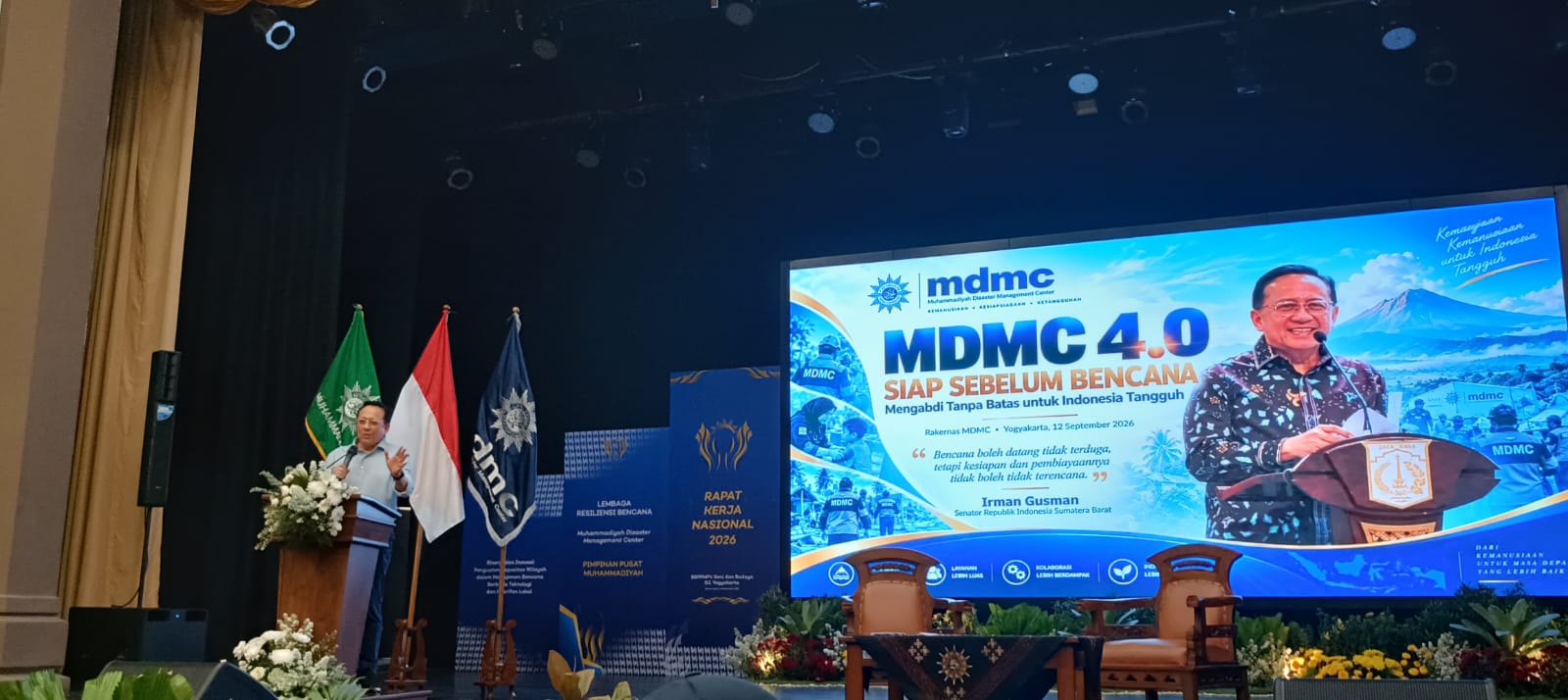
Yogyakarta — DPD RI Senator from West Sumatra, Irman Gusman, urged the Muhammadiyah Disaster Management Center (MDMC) to ensure its network of volunteers, logistics, health services, and funding is ready for deployment before a crisis strikes. Through the concept of MDMC 4.0, he called on Muhammadiyah to convert public trust into tangible capability to protect citizens and accelerate the recovery of their livelihoods.
Irman shared this concept as the keynote speaker before hundreds of participants, consisting of leaders and members of LRB-MDMC PP Muhammadiyah as well as regional MDMC management from across Indonesia. The event aimed to strengthen Muhammadiyah's disaster management strategic direction and was held at the Center for Development and Quality Assurance of Vocational Education in Art and Culture, Sleman, Yogyakarta, on Saturday (Sept 12, 2026).
During the opening of the National Working Meeting (Rakernas) on Friday (Sept 11, 2026), the schedule featured opening remarks by the Chairman of LRB-MDMC PP Muhammadiyah, H. Budi Setiawan, S.T.; an address by the Coordinating Minister for Human Development and Cultural Affairs, Prof. Dr. Pratikno, M.Soc.Sc.; and an official mandate and opening of the Rakernas by the General Chairman of PP Muhammadiyah, Prof. Dr. Haedar Nashir, M.Si.
Irman Gusman, who currently serves as the Chairman of the Advisory Board for West Sumatra MDMC, emphasized that MDMC’s position has grown increasingly strategic because it operates under the larger umbrella of Muhammadiyah, an organization with deep roots in society and high levels of public trust. Meanwhile, networking is a vital factor because disaster management cannot be handled by a single institution alone. The government, private sector, universities, community organizations, and grass-roots communities possess resources and capacities that complement one another.
“Public trust is social capital. However, that trust must be translated into capacity: the ability to connect resources, make decisions, and rapidly mobilize aid when society needs it,” Irman stated.
The urgency is reflected in the 2025 World Risk Index, which ranks Indonesia 3rd out of 193 countries with a score of 39.80. The Philippines holds the 1st position with a score of 46.56, followed by India in 2nd place with a score of 40.73. This index measures risk through exposure to hazards and societal vulnerability, including limited capacity to cope with and adapt to disasters. This means that strengthening community preparedness is an essential component of reducing overall risk.
The 2nd Chairman of the DPD RI explained this strengthening framework as MDMC 4.0 or the Integrated Humanitarian and Resilience Network. He noted that the term is a conceptual idea rather than an official organizational nomenclature. The concept builds upon ongoing efforts in emergency response, disaster management, and resilience building.
Under this model, MDMC acts as a hub connecting Muhammadiyah's strengths with the government, private sector, universities, healthcare workers, media, and communities. Schools, hospitals, mosques, and volunteer networks can support one another continuously, from preparedness phase to the restoration of community livelihoods, explained the Chairman of the Supervisory Board of the Minang Family Association (IKM).
This institutional foundation also received praise from the government. At the Rakernas opening on Friday (Sept 11), Coordinating Minister for Human Development and Cultural Affairs Pratikno noted that Muhammadiyah's network of charitable endeavors plays a crucial role in public safety, with schools, university campuses, hospitals, and clinics supporting one another during disaster management.
According to the Chairman of the Expert Board of the PP Muhammadiyah Economic and MSME Council, the network needs to establish a trigger mechanism—an agreed-upon action procedure set in place before a crisis occurs. The protocol must clearly define the data to be used, authorized entities to activate the network, division of roles, deployment of resources, and public accountability. Consequently, coordination would not need to start from scratch every time a disaster occurs.
“What matters is not just who moves, but how all existing resources can mobilize immediately when needed. That is the importance of a trigger mechanism,” he noted. Irman also stressed the importance of treating mitigation as a development investment. A study by the World Bank and GFDRR on resilient infrastructure estimates a return of roughly $4 for every $1 invested in low- and middle-income countries. The benefits include reduced structural damage and fewer disruptions to services essential for sustaining lives and economic activities.
“Mitigation and preparedness are investments to safeguard lives, maintain public services, and preserve economic sustainability. Every single rupiah spent before a disaster strikes should be directed toward minimizing losses and speeding up recovery,” he asserted.
Therefore, it is hoped that this Rakernas will solidify collaborative efforts supported by regular training, work standards, resource allocation, and clear success indicators. Protection for citizens must extend until healthcare services, psychosocial support, and livelihoods are fully restored.
“We cannot always prevent disasters, but we can reduce their impact. For this reason, we must enhance preparedness, expand networks, and ensure every resource can move as one when humanity calls,” concluded the Chairman of the Advisory Board of the Minangkabau Cultural Center.
For context, the three-day Rakernas series concluded on Sunday, September 13, 2026, and was officially closed by former Vice President Jusuf Kalla, who also serves as the Chairman of the Indonesian Red Cross (PMI).
AGENDA KEGIATAN
DEWAN PERWAKILAN DAERAH REPUBLIK INDONESIA