Informasi Seputar Kegiatan di DPD RI
AGENDA KEGIATAN
DEWAN PERWAKILAN DAERAH REPUBLIK INDONESIA
17 October 2026 oleh admin
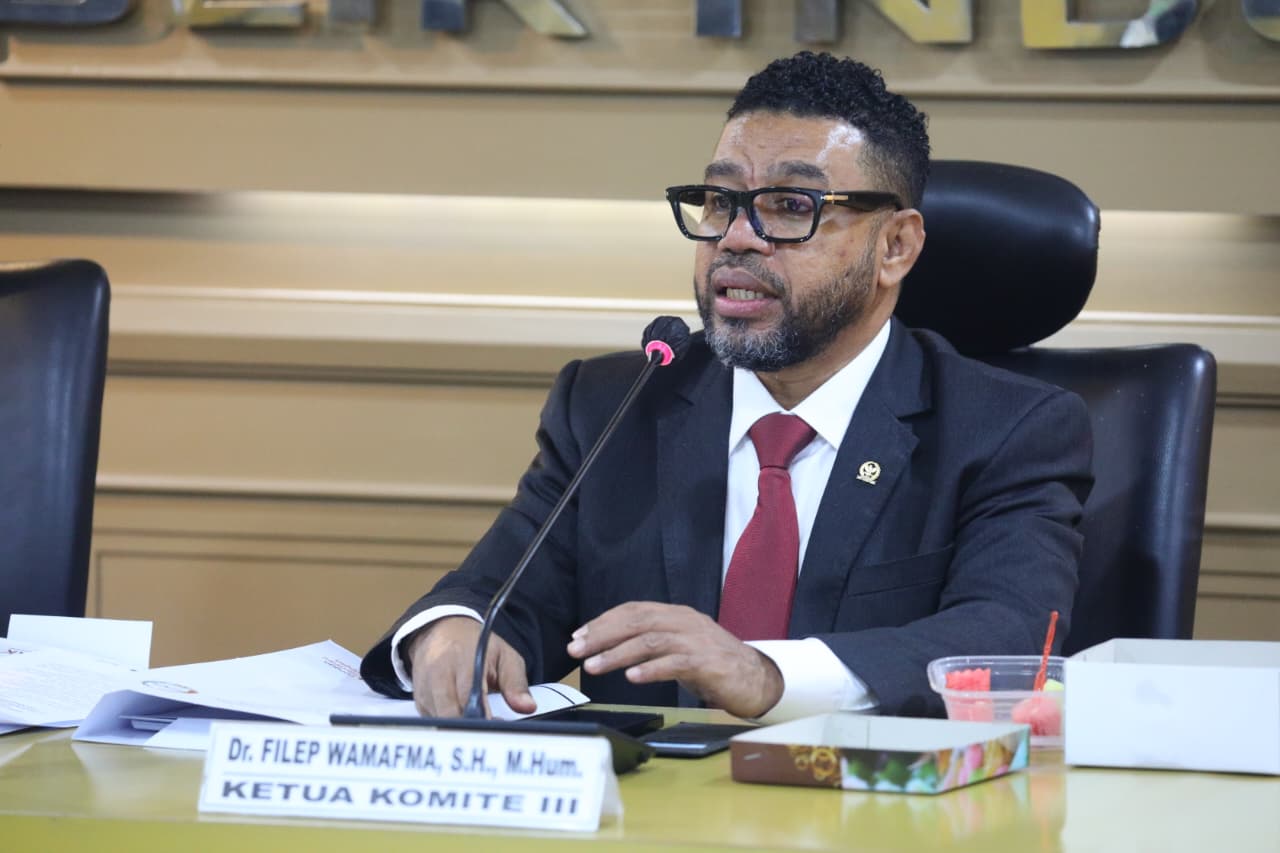
Jakarta, dpd.go.id — Chairperson of Committee III of the House of Regional Representatives of the Republic of Indonesia (DPD RI), Filep Wamafma, urged the Minister of Religious Affairs to immediately take decisive and measured steps in responding to alleged sexual violence against children within educational environments, which has recently drawn increasing public concern.
According to Filep, this issue does not only concern law enforcement against alleged perpetrators, but also involves the government’s responsibility to ensure child safety, effective oversight, and the quality of student protection within educational institutions.
“I urge the Minister of Religious Affairs to conduct a comprehensive evaluation of the supervision and child protection systems in educational institutions under his authority. The safety of students must be the top priority. There is no compromise when it comes to sexual violence against children,” Filep stated on Saturday (10/17/2026).
He emphasized that oversight of educational management should not be limited to licensing controls, administration, and institutional compliance. The government must also ensure the existence of violence prevention mechanisms, safe reporting channels, and prompt, responsible handling of complaints.
“The government's responsibility in delivering education requires a supervision system capable of detecting risks and preventing violations of students' rights. Therefore, the Minister of Religious Affairs needs to ensure that all educational units under his jurisdiction consistently enforce child protection standards, including through periodic evaluations of policy implementation and grievance mechanisms,” explained the figure popularly known as Pace Jas Merah.
Furthermore, the Vice Chair of the DPD RI Special Committee highlighted several relevant legal bases as references for handling and oversight. Among them is Law Number 12 of 2022 on the Crime of Sexual Violence, which regulates the prevention and handling of sexual violence crimes, including victims' rights to care, protection, and recovery.
He also cited Law Number 35 of 2014 amending Law Number 23 of 2002 on Child Protection—which reinforces the obligation to protect children from violence and treatment harmful to their development and future—as well as Presidential Regulation Number 12 of 2025 on the National Medium-Term Development Plan (RPJMN) 2025–2029.
“National development policies place the improvement of human resources quality and community protection as central parts of the development agenda. Child protection within educational environments must run hand in hand with improving educational quality,” he noted.
“Based on this framework, addressing alleged sexual violence is not solved merely by prosecuting criminal cases. The government must also evaluate whether prevention and supervision systems are functioning effectively,” stressed the leader of Committee III of the DPD RI, which oversees education matters.
Key Recommendations to Prevent and Handle Child Abuse
On the same occasion, Filep emphasized that within its duties, Committee III of the DPD RI covers portfolios relating to education, religion, as well as women's empowerment and child protection. Therefore, student protection issues are directly relevant to carrying out their oversight function over government policies.
He outlined several recommendations, including: First, comprehensive evaluation and inspections: This evaluation targets the effectiveness of oversight, the enforcement of student protection standards, and complaint handling mechanisms. If administrative violations are uncovered, action must be taken in accordance with applicable laws.
Second, ensuring law enforcement proceeds without intervention: Handling alleged criminal offenses falls under the jurisdiction of law enforcement agencies. The Ministry of Religious Affairs must support the process through necessary coordination without hindering investigations or prosecutions. Any party proven to have committed a crime must be held accountable under the law.
Third, guaranteeing protection and recovery for victims: The government must ensure victims receive identity protection, psychological counseling, legal assistance, and access to a safe learning environment. Protection must also extend to preventing intimidation and actions that could cause victims to suffer recurring trauma.
“Every report of alleged violence against children serves as a crucial alarm to strengthen protection and oversight systems on an ongoing basis. Prevention is paramount, but we must also ensure that the supervision system works, every complaint is followed up, victims receive protection, and any party proven to have broken the law is held accountable,” he added.
Simultaneously, Filep assessed that success in education is measured not only by academic performance and graduation rates, but also by the ability of national policies and systems to guarantee the safety, dignity, and rights of every child.
“Education must be a safe space to learn, grow, and build a future. Child protection is a duty that must be carried out by all parties according to their respective responsibilities and authority,” he concluded.
AGENDA KEGIATAN
DEWAN PERWAKILAN DAERAH REPUBLIK INDONESIA